

Short answer: Plan one main site per morning, finish before midday heat, give children bottled water only, and see a travel clinic about 6 weeks before you fly. Children dehydrate faster than adults, so carry oral rehydration solution. Children under 6 enter the Egyptian Museum free.
Key facts
- Travel clinic visit
- About 6 weeks before departure (Government of Canada)
- Hepatitis A vaccine
- Recommended for unvaccinated travellers aged 1 year and over (CDC)
- Free museum entry
- Children under 6 at the Egyptian Museum and the Grand Egyptian Museum (admission fee); the National Museum of Egyptian Civilization lists it, with a Friday, Saturday and holiday caveat (Ministry, GEM, 28 October 2026)
- Sun protection
- SPF 15 or higher, and shade from 10 a.m. to 4 p.m. (CDC)
- Water
- Tap water is not safe outside international tourist hotels (CDC Yellow Book)
- Photography
- Taking pictures of children is prohibited (GOV.UK)
What pace works for children in Egypt?
Keep days short and put the main site in the morning. The Valley of the Kings, Karnak and Hatshepsut’s temple open at 6:00, and the Giza Plateau opens at 8:00, according to the Ministry of Tourism and Antiquities. That lets you finish before midday, rest at the hotel, and go out again late in the afternoon.
Plan on fewer sites than an adult itinerary, and build in a pool afternoon. Long transfers are harder on children: Canada’s health advice notes that motion sickness is a risk for ages 2 to 12, so bring remedies suitable for their age and ask a pharmacist. For a gentler route, a short Cairo base, a flight to Luxor and one cruise or hotel stay in the south keeps changes of bed low. Our first-time planning guide shows the transport times.
Related tripsFamily Egypt toursPrivate trips with short site mornings and rest time.Which sites suit children?
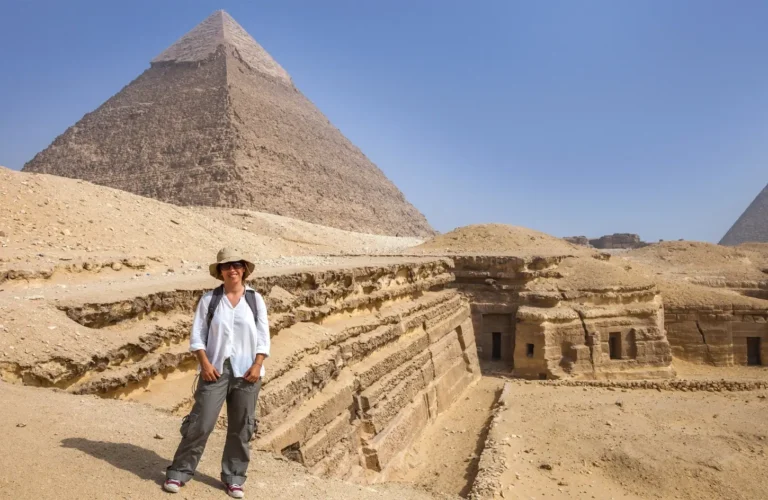
Choose sites with open space, short queues and things to look at. The Giza Plateau and the Sphinx are outdoor, and the area ticket does not cover going inside the three main pyramids (Ministry). Inside the Great Pyramid is a separate ticket, so decide on the day whether a child is comfortable with enclosed spaces.
Museums are cooler than the open sites. The Egyptian Museum in Tahrir is open daily from 9:00 to 17:00, and the National Museum of Egyptian Civilization from 9:00 to 17:00 with evening hours from 18:00 to 21:00. The Egyptian Museum admits children under 6 free. The National Museum of Egyptian Civilization page says the same, but its free-ticket list excludes Friday, Saturday and public holidays, so check before you go on those days. At the Grand Egyptian Museum, children under 6 are exempt from the admission fee, though they pay the difference for a guided tour, and children must be accompanied by an adult at all times. The Eternal Sun evening show is not open to children under 6, according to its booking terms (checked 28 October 2026).
The Luxor temples are large. Karnak has a Great Hypostyle Hall of 134 columns, and Luxor Temple stays open until 20:00, so an evening visit is cooler (Ministry). Our 7 days in Egypt itinerary shows how these fit into a week.
How do you handle the heat with children?
Start early, cover up and drink often. The CDC Yellow Book says desert summer temperatures exceed 38 degrees Celsius, that thirst is a late sign of dehydration, and that sweat evaporates quickly so dehydration can go unnoticed. Luxor’s mean daytime high is about 41 degrees in June and July and about 23 in January (Wikipedia, 1991-2020 climate table).
The CDC recommends sunscreen with an SPF of at least 15, protective clothing and shade between 10 a.m. and 4 p.m. It also advises eating and drinking regularly, wearing loose, lightweight clothing and limiting physical activity in high temperatures. For babies and toddlers, ask your doctor about sun products for their age. Canada’s advice says children dehydrate faster than adults and recommends oral rehydration solution if they have diarrhoea.
What should children eat and drink?
Give them bottled water and cooked food. The CDC Yellow Book says tap water is adequately chlorinated in most large international tourist hotels, but bottled water is generally provided for drinking, and that tap water elsewhere is not safe. Thoroughly cooked meat and vegetables are generally safe in tourist hotels, on Nile cruise ships and in tourist restaurants. Raw or undercooked meat and shellfish should be avoided, and uncooked vegetables and salads are questionable.
Canada’s rule is simple: boil it, cook it, peel it or leave it. For infants, Canada advises breastfeeding if possible and washing bottles, pacifiers and toys in disinfected water. Travellers’ diarrhoea risk is rated high in the CDC chapter, so pack oral rehydration salts and ask your doctor what to do if a child becomes ill.
Which vaccines and health steps should you check?
See a doctor or travel clinic early. Canada’s advice is about 6 weeks before departure, and GOV.UK’s health page says at least 8 weeks. The CDC recommends hepatitis A for unvaccinated travellers aged 1 year or older, typhoid for most travellers, and measles protection (MMR) for all international travellers. Egypt requires proof of yellow fever vaccination for travellers aged 9 months and older arriving from countries with a risk of yellow fever transmission (CDC Yellow Book). The CDC does not recommend a yellow fever vaccine for direct travel from the US.
Insects and animals matter too. Dengue is increasingly reported, so use repellent that suits your child’s age (Canada recommends DEET or icaridin on exposed skin but not on children’s hands). Rabies is endemic: keep children away from stray dogs and cats, and if a child is bitten, scratched or licked on broken skin, wash for at least 15 minutes with soap and water and get medical help at once.
Avoid wading or swimming in the Nile and irrigation canals because of schistosomiasis. Chlorinated pools and the Red Sea do not carry that risk (CDC Yellow Book). The CDC also notes a norovirus risk on Nile cruises, so wash hands often.
What about car seats, safety and local rules?
Bring your own booster or child seat. Canada says a booster seat may not be available at your destination, and suggests a carrier instead of a stroller on unpaved roads. GOV.UK says drivers and front-seat passengers must wear seatbelts. Do not take photos of Egyptian children, which is prohibited, and ask before photographing any Egyptian citizen (GOV.UK, Experience Egypt).
Dress rules apply to children too at mosques, churches and synagogues, where shoulders and legs must be covered (Experience Egypt). If a child becomes ill, the CDC notes that hotels must have an onsite clinic and resident physician, and the ambulance number is 123 (GOV.UK).
What does a good day with children look like in Luxor?
Split it in two, with a long gap in the middle. The Ministry of Tourism and Antiquities lists the Valley of the Kings and Karnak as open from 6:00 to 17:00, and Luxor Temple until 20:00. That allows a first visit at opening, a hotel pool break through the hottest hours, and Luxor Temple after sunset, when the open stone has cooled.
- 6:00 to 9:00: one main site, with water and sun protection.
- 9:00 to 16:00: breakfast if you have not eaten, then rest, pool and lunch.
- Late afternoon: a short walk or a boat ride on the river.
- After dark: Luxor Temple, which stays open until 20:00.
Children who wake at dawn on holiday will like the early start. Those who do not should get the evening visit instead of the morning one.
Which sites near Cairo suit families?
Saqqara is an outdoor option with a smaller crowd than Giza. The Ministry lists it as open daily from 8:00 to 16:00, with a foreigner area ticket for adults and students, and an inclusive ticket that covers the Imhotep Museum, the noble tombs, the New Kingdom tombs and the Tombs of Mereruka and Mehu. The Pyramid of Djoser, the Southern Tomb and the Serapeum are listed as separate tickets (checked 29 October 2026).
The ticket categories are adult and student, and the page gives no child rate, so ask at the gate how a child is charged. Vehicle fees are listed too, by vehicle type. Giza has the same 8:00 to 16:00 hours, which leaves a short window if a child sleeps in or wakes late from a nap.
What should you ask a doctor before you go?
Ask about vaccines, ask about medicines and ask about rabies. Canada says to see a health care provider about six weeks before departure, to check routine vaccines and to consider flu shots for children over six months. The UK Foreign Office says to check vaccine advice at least eight weeks ahead.
It also says that some prescribed and over-the-counter medicines are controlled in Egypt, and that you may need permission from the Ministry of Health before arrival. Without it you may not be allowed to bring a medicine in, and you may be prosecuted. If you travel with a child’s prescription, carry a GP letter that states the condition, the amount and that it is for personal use.
What if a child gets sick away from the hotel?
Know the warning signs. Canada says to seek medical attention for severe dehydration, bloody diarrhoea, diarrhoea with high fever, persistent vomiting or no improvement with oral rehydration solution. It also says to avoid bismuth subsalicylate, found in some stomach remedies, for children and breastfeeding mothers.
The UK Foreign Office warns that some hotel doctors have overcharged for treatment and medicines, and that pharmacies outside hotels often charge less. Call 123 for an ambulance. A hotel doctor is still the quick first step for a child with a fever, and you can compare prices for medicines afterwards.
Does altitude matter for children in Egypt?
Only in the Sinai mountains. The CDC Yellow Book gives Mount Sinai as 2,285 m above sea level, and Canada says medical authorities recommend children avoid altitudes above 2,500 m. So the summit is below that figure, but Canada also says that if you cannot avoid higher ground you should climb no more than 300 m a day and rest every 1,000 m. Signs in children include vomiting, poor appetite and irritability.
The Nile valley, Cairo, Alexandria and the Red Sea coast are close to sea level. The question arises only if you plan a Sinai trip, and that is a decision for you and a doctor, not for a travel guide.
How do you handle flights and jet lag with children?
Plan for ear pain and a reset. Canada says ear pain from pressure changes on landing is more common in children, and suggests bottle or breast feeding for infants and chewing gum, swallowing or yawning for older children. It also says to check with the airline first for a newborn of one to two weeks old, since some airlines do not allow newborns to fly.
For jet lag, Canada advises short daytime naps, since long ones make night sleep harder, plus daylight and the local schedule. Build an easy first day around that advice, not a full itinerary.
What helps at each age?
| Age | What helps | Source |
|---|---|---|
| Infants | Breastfeeding if possible; wash bottles and pacifiers in disinfected water; a carrier on unpaved ground | Government of Canada |
| Under 6 | Free entry to the Egyptian Museum; bring your own car seat; keep naps short and in daylight | Ministry, Canada |
| Ages 2 to 12 | Remedies for motion sickness on long road transfers | Government of Canada |
| Students | Foreigner student tickets are half the adult price at the sites we checked | Ministry |
| Teenagers | Same sun and dress rules as adults | CDC, Experience Egypt |
What are the common mistakes with children in Egypt?
- Planning two big sites before lunch because the first one went quickly.
- Letting a child drink from a tap outside the large hotels.
- Skipping a doctor visit because the trip is short.
- Packing a medicine without checking the rules on controlled drugs.
- Leaving the car seat at home and hoping a rental has one.
- Photographing local children, which GOV.UK says is prohibited.
What should you skip?
Skip the full-day marathon, the unpaved-road stroller and the midday open site in summer. Skip a night Sinai climb with young children unless a doctor agrees. Skip anything that makes the child choose between food you do not trust and no food, by carrying safe snacks instead.
Keep readingHow far in advance to book EgyptFor a Nile cruise or tour between October and February, our advice is to book about...What did we not find?
We found no official page that sets a child rate for the temples and tombs, so we do not give one. We also found no official minimum age for the Grand Egyptian Museum galleries, beyond the rules in the section above. Ask the site for both.
How does Egypt with children fit a trip?
A calm shape works better than a long one. Three nights in Cairo, a flight to Luxor and a few nights in the south give you the big sights with few bag moves. Our Egypt travel tips cover the practical basics for the whole family.
Who does Egypt not suit with children?
It is a hard trip for families who want no early mornings, no long transfers and no heat. A June to August trip to Luxor and Aswan is the hardest for small children, with daytime highs of 39 to 40 degrees. Families with a baby may prefer a shorter Cairo-only trip, or a winter visit. If you want a route arranged for you, start from Egypt tour packages.