

Short answer: October to April suits Cairo, Giza, Luxor and Aswan, when average daytime highs run from about 19 to 35 degrees Celsius. The Red Sea is warm all year, with Hurghada's average high between 21.7 and 35.1 degrees. Alexandria is the coolest of the five, at 18.3 to 30.4 degrees.
Key facts
- Cairo, hottest month
- July, mean daily high 34.8 °C (WMO 1981-2010 normals)
- Luxor, hottest months
- June to August, mean daily highs of 41.0 to 41.4 °C
- Aswan, June to August
- Mean daily high 41.2 to 41.4 °C
- Comfortable months
- November through March (Wikivoyage); Nile cruise season October to February (Wikipedia)
- Hurghada sea temperature
- 21 °C in February and March, 28 °C in August
- Alexandria, wettest months
- December, January and February (40 to 53 mm)
Which months suit Egypt overall?
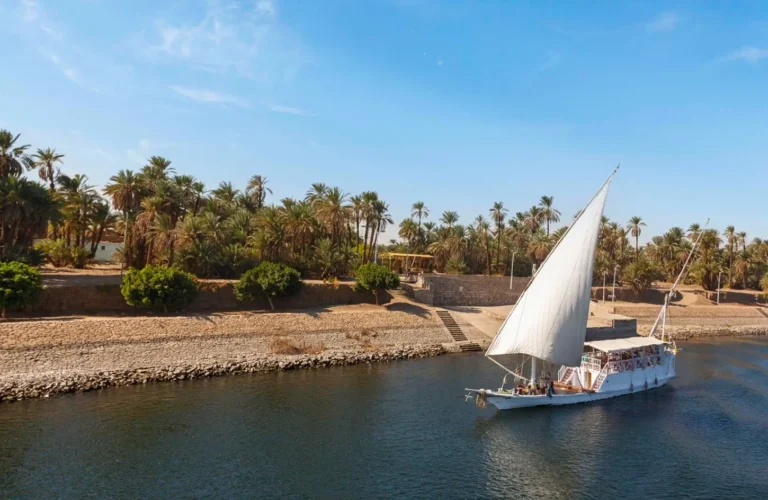
Wikivoyage calls November through March the most comfortable months for travel in Egypt, and the World Meteorological Organization (WMO) temperature data below agree for Cairo, Giza, Luxor and Aswan. Wikipedia’s Nile cruise entry gives October to February as the preferred cruising season. The other months get hot, as the tables show.
The shoulder months are the practical answer if you want warmth without the winter chill. In October and April Luxor’s mean daily high is 35.3 °C in both months, against 29.0 °C in November and 29.5 °C in March. We found no official source on crowd levels by month, so this guide ranks months by weather only.
Related tripsClassic Egypt toursCairo, Luxor and Aswan at a comfortable pace.Which months suit Cairo and Giza?
Cairo is comfortable from November to April. The WMO 1981-2010 normals for Cairo Airport, supplied by the Egyptian Meteorological Authority, show mean daily highs of 19.0 °C in January, 23.4 °C in March, 28.2 °C in April and 24.7 °C in November. July peaks at 34.8 °C.
Spring brings wind. Wikivoyage warns that sandstorms may occur from March to May, and the Government of Canada’s travel advice says sand storms and dust storms can occur in the spring.
Which months suit Luxor and Aswan?
Luxor and Aswan work best from November to March. Mean daily highs in Luxor run from 23.0 °C in January to 29.5 °C in March, and in Aswan from 22.9 °C to 29.4 °C. From May to September they sit between about 39 and 42 °C.
Wikivoyage calls December, January and February the coldest months of the year, and says southern Nile Valley days are milder than in the north while nights are about as cool. Wikipedia gives October to February as the preferred Nile cruise season.
Which months suit the Red Sea?
The Red Sea is a year-round beach destination, so the right month depends on heat tolerance. WMO normals for Hurghada show mean daily highs of 21.7 °C in January and 35.1 °C in August. Sea temperature, which the WMO page does not give, runs from 21 °C in February and March to 28 °C in August according to Wikipedia.
Hurghada’s mean daily high stays below 30 °C from November to April and reaches 35.1 °C in August. The sea is 25 °C in November, 24 °C in May and 27 °C in September. We found no official source on resort crowd levels by month, so ask a hotel about the weeks you want.
Which months suit Alexandria?
Alexandria is mildest in spring and autumn, and winter is the wet season. WMO normals for Alexandria show mean daily highs of 18.3 °C in January, 24.0 °C in April and 30.4 °C in August. December to February are the wettest months, at 46.7 mm, 52.9 mm and 40.2 mm for December, January and February respectively.
Wikipedia’s tables put Alexandria’s sea at 26 °C in August and September and 17 °C in February and March. April (24.0 °C) and October (27.4 °C) are the months when the air is warm without the highs near 30 °C of July and August.
What does each region look like in a table?
| Region | Comfortable months | Hottest months (mean daily high) | Notes |
|---|---|---|---|
| Cairo and Giza | November to April | June to September, 33.1 to 34.8 °C | Dust possible from March to May |
| Luxor | November to March | June to August, 41.0 to 41.4 °C | Preferred Nile cruise season is October to February |
| Aswan | November to March | June to August, 41.2 to 41.4 °C | January lows average 8.8 °C |
| Red Sea (Hurghada) | Year round; highs stay below 30 °C from November to April | July and August, 35.0 to 35.1 °C | Sea 21 °C in February and March, 28 °C in August |
| Alexandria | April and October; winter is wet | August, 30.4 °C | Wettest from December to February |
Temperatures are 1981-2010 averages from the WMO World Weather Information Service, with data from the Egyptian Meteorological Authority. Sea temperatures come from Wikipedia. We give no crowd levels because we found no official source for them.
What do the temperatures look like month by month?
The table gives mean daily highs in °C for four places, from the WMO World Weather Information Service. Read across a row to compare a month, or down a column to see a season.
| Month | Luxor | Aswan | Hurghada | Alexandria |
|---|---|---|---|---|
| January | 23.0 | 22.9 | 21.7 | 18.3 |
| February | 25.1 | 24.8 | 22.7 | 18.6 |
| March | 29.5 | 29.4 | 25.4 | 20.6 |
| April | 35.3 | 35.2 | 29.3 | 24.0 |
| May | 39.0 | 39.0 | 31.8 | 26.3 |
| June | 41.3 | 41.2 | 33.9 | 28.7 |
| July | 41.4 | 41.4 | 35.0 | 29.9 |
| August | 41.0 | 41.2 | 35.1 | 30.4 |
| September | 39.3 | 39.5 | 33.3 | 29.8 |
| October | 35.3 | 35.7 | 31.3 | 27.4 |
| November | 29.0 | 29.0 | 27.0 | 23.7 |
| December | 24.3 | 24.2 | 23.2 | 20.1 |
Luxor and Aswan reach 39 °C or more from May to September, while Alexandria never passes 30.4 °C. Easter, Eid and Christmas dates move, so check them against your own year before you book.
Does Ramadan change when I should go?
It can. The Government of Canada says Ramadan is expected to begin on or around 7 February 2027, so part of February and early March 2027 falls inside it. Eating, drinking and smoking in public should be discreet from sunrise to sunset, according to the same page.
The Ministry of Tourism and Antiquities lists shorter Ramadan hours at some museums, for example 9:00 to 16:00 at the Egyptian Museum in Cairo. Ramadan dates move through the calendar, so check them for your own year.
What are khamsin winds, and when do they hit?
The khamsin is a hot desert wind that usually blows between March and May, per The National. It marks the shift from spring to summer heat and can carry sand across Cairo. The Government of Canada’s travel advice, updated 26 May 2026, says sandstorms and dust storms can occur in spring and advises staying indoors with windows closed.
The effects can be sharp. The Egyptian Meteorological Authority issued a high-impact alert on 29 April 2025 for winds of 40 to 60 km/h with gusts up to 80 km/h. The Education Ministry then closed schools nationwide, and the authority told people to wear masks outdoors and drive with great care (The National, 30 April 2025).
The Egypt Independent reported on 15 April 2026 that the authority expected Greater Cairo to reach about 35 °C and Upper Egypt about 38 °C, with dust until 20 April, before temperatures fell to about 27 °C. A khamsin can therefore bring a hot spike followed by a quick cooling.
Can weather cancel a balloon flight or a morning visit?
Yes, on windy and dusty days. Dust and strong wind can change the flight plan for Luxor balloon rides. Ahram Online reported on 28 May 2023 that the Ministry of Civil Aviation held the scheduled rides for a third day running because of dusty winds. Keep a spare morning in your Luxor days, and pick a flight early in your stay so a weather delay can be moved.
The lesson is to build slack into any plan that depends on a morning flight. Give yourself a spare day in Luxor, and do not book a tight connection straight after a balloon morning.
Does rain matter anywhere in Egypt?
Only in the north, and only in winter. Canada’s advice says heavy rain can cause severe flooding in low-lying areas of northern Egypt and advises following local instructions. That fits the Alexandria figures above, where January averages 52.9 mm, while Luxor and Aswan get very little rain.
For most itineraries this means one thing: pack a light waterproof layer for Alexandria and Cairo between December and February, and leave it out for Aswan.
Which month fits which kind of traveller?
| Traveller | Months to look at | Reason from the sources |
|---|---|---|
| First-time visitor with a Nile Valley route | November to March | Luxor and Aswan stay under about 30 °C on average in these months |
| Traveller who dislikes cold nights | March or November | Luxor lows of 11.8 and 12.3 °C, against 5.9 °C in January |
| Beach traveller | September to November, or May and June | Hurghada’s sea is 24 to 27 °C in those months |
| Nile cruise traveller | October to February | Wikipedia names this as the preferred cruising season |
| Traveller who needs a flight at dawn | Winter, with a spare day | Wind and dust can ground flights in spring |
| Summer traveller | Any, with early starts | Heat peaks at midday |
How do Ramadan and the Abu Simbel sun festival line up in 2027?
They overlap. Canada says Ramadan is expected to begin on or around 7 February 2027, and the Ministry of Tourism and Antiquities gives 22 February as one of the two dates when sunlight enters the Great Temple at Abu Simbel. That puts the 2027 February date inside Ramadan, so check hours and meal arrangements first. Our Abu Simbel guide covers the festival itself.
How should you pack for the temperature swings?
Pack for two climates in winter. Cairo’s mean daily high is 19.0 °C in January and Luxor’s is 23.0 °C, but nights are far colder. The WMO tables put January lows at 9.7 °C in Cairo, 5.9 °C in Luxor and 8.8 °C in Aswan.
- Winter: a warm layer for dawn starts, light clothing for midday.
- Spring: a scarf or mask for dust, and a hat.
- Summer: loose clothing, sun protection and water, as the CDC advises for desert heat.
- Autumn: a light layer for evenings, since highs fall to about 25 °C in Cairo in November.
What if I can only travel in summer?
Plan Nile Valley sightseeing for the first hours of the day, and spend afternoons indoors or at the coast. Wikivoyage describes summers as hot, dry and very sunny, with more humid air on the coast. If heat is a concern, the cooler months are the safer choice. Our day tours and Nile cruises pages show what is on offer, and the trip planning page takes your dates.