
Felucca on the Nile
A lateen-sailed boat, crewed by two or three people, with room for about ten
 5.0 on TripadvisorPrivate tour
A private half day on the water and on the west bank of Aswan: a felucca across the Nile, then a walk through a Nubian village with your guide.
From, per person$506 or more travellers
This tour is about people, not pharaohs. You cross the Nile in a felucca, the wooden sailboat that has carried passengers on this river for centuries, and land on the west bank at Gharb Soheil, a Nubian community on a sandy slope above the water. The village was founded about a century ago, when the old Aswan Dam was built.
Your guide gives the background as you walk: why Nubian families moved, what the High Dam took from them in the 1960s, and which language they speak at home. Where a host family is available, you stop for tea in a house. There are no ticketed monuments on this tour, so it works as a calm second day after a heavy sightseeing one.
It suits couples, families with older children and anyone who prefers slow travel. It does not suit travellers who want to tick off temples, or anyone who cannot step into and out of a small boat. The felucca depends on wind, so the crossing can be quick or slow.
A lateen-sailed boat, crewed by two or three people, with room for about ten
A Nubian village on the west bank, reached only by water
Painted fronts and decorated gates, as found across Nubian settlements
When a host is available, in a Nubian home
Seen from the river, pink limestone with a large central dome
Your guide meets you and drives you to the Corniche, where the feluccas tie up along the east bank. You meet the crew and settle in. The boat is private to your group. We confirm the pickup time for your date when you book.
The boat moves upstream along the east bank. Elephantine Island, the long island in front of the city, slides past, and your guide points out the ruins at its southern end. Nubian families also live in three villages in the middle of the island. Ask your guide how they differ from the one you are about to visit.
The boat turns west toward the hill above the river. On the high point you see the Mausoleum of Aga Khan III, finished in 1960. The interior has been closed to the public since 1997, so the river is where you see it from. If the wind drops, the crossing takes longer, and your guide uses the time to talk.
You land on a sandy slope. The village is reached only by boat. Houses here are usually plastered and painted in strong colours, and many have an ornate gate and a courtyard. Your guide explains the painted motifs on the walls and where the people of Gharb Soheil came from. Nubians in Egypt speak Nubian languages at home, including Kenzi and Nobiin, and most also speak Arabic.
When a host family is available, you stop for tea or coffee in a family house. Henna painting and local handicrafts are sometimes on offer, and anything you want to buy is your choice and your cost. The pace here is yours. We confirm what the visit includes for your date when you book.
The crew sails or motors back to the east bank, depending on wind and light. The car meets you at the landing and takes you back to your hotel or ship.
| Group size | Price per person |
|---|---|
| Single traveller | $80 |
| 2 travellers | $65 |
| 3 to 5 travellers | $55 |
| 6 or more travellers | $50 |
In US dollars, per person, for a private trip. The price in your written quote, made for your dates and group, is the one that counts. International flights are not included.
Gharb Soheil is a place where people live. Ask before you photograph a person or step into a courtyard, and cover your shoulders and knees. Your guide will tell you where photographs are welcome.
The felucca has little shade and the wind can change fast. Bring a hat, sunscreen, sunglasses and a light layer for the water. Average highs in Aswan are above 40 °C from June to September.
Boarding means a short step over a gap and onto a low deck. Tell us in advance if you have limited mobility. The village slope is sandy and uneven.
Send every cancellation by email so that we can confirm it in writing. The charge is a percentage of the tour price, and anything you paid above it is refunded.
| Days before arrival | Normal dates | 18 Dec to 5 Jan |
|---|---|---|
| Until 61 days | 20% | 35% |
| 60 to 31 days | 35% | 50% |
| 30 to 15 days | 50% | 75% |
| 14 to 1 days, or no-show | 100% | 100% |
A bank and payment fee of 6 percent is deducted from every refund. Full rules: terms and policies.
Please give the age of every child at the time of travel when you ask for a quote.
Travel tips
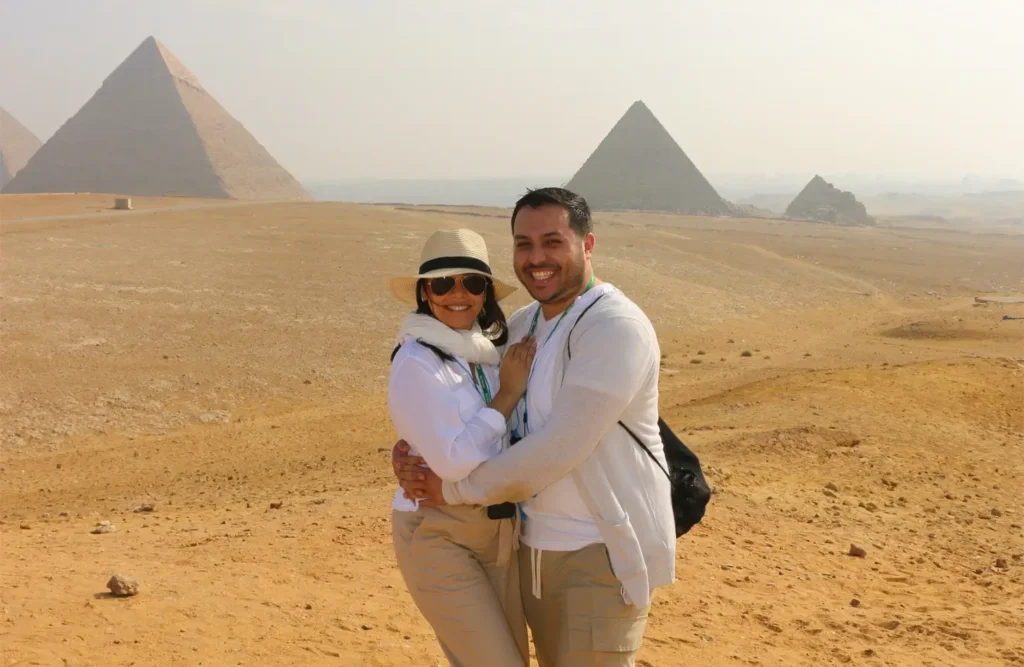
Pickup around 8:00 gets you to the pyramids before the heat and the coach groups.
Closed shoes, a hat and sunscreen, expect sand, steps and uneven ground.
Entry inside the Great Pyramid is an optional ticket bought on the day.
Photos are free outdoors; some tombs charge for cameras. Drones are not allowed.
Traveller reviews
“The entire trip was seamlessly executed.”
“He made our trip to the pyramids and Alexandria fun and memorable.”
“My friends and I spent two weeks in Egypt and he was with us every step of the way.”
FAQ
Still unsure? Message us on WhatsApp and a real person from our team will answer.
People live in the houses and keep their own customs. Visits are arranged with host families, and the village continues its life around you.
A traditional wooden sailboat with a single sail, or two lateen sails on the Nile. It is still used for transport in Aswan and Luxor, and carries about ten passengers with a crew of two or three.
The Aswan dams flooded much of Lower Nubia, and about 100,000 to 120,000 people were resettled after the High Dam. Some Nubian families live in villages like Gharb Soheil, others were moved to settlements near Kom Ombo.
No. The only monument you see up close is the ruins area on Elephantine from the water. For ticketed sites, combine it with Philae or the Aswan city tour on another day.
Make it a trip
 Honeymoon Egypt Packages 8 days / 7 nights
Aswan · Cairo · Luxor
Cairo for two nights, a balloon over Luxor at dawn, then 4 nights on the Nile to Aswan with a felucca sail. A private guide and car throughout.
 Luxury Egypt Tours 8 days / 7 nights
Aswan · Cairo · Luxor
Three nights in Cairo, a short flight to Luxor, then 4 nights on a Deluxe or Ultra Deluxe ship sailing upriver to Aswan. Private guide and car.
 Classic Egypt Tours 9 days / 8 nights
Alexandria · Aswan · Cairo · Luxor
Cairo, one night on the Mediterranean in Alexandria, then 3 nights on the Nile from Aswan to Luxor. Two domestic flights.
Before you go
You may also like
 12 Hours
Abu Simbel, Aswan
 7 Hours
Aswan
 3 Hours
Aswan
Tell us your dates. We’ll send a day-by-day plan and a clear price.
Free and no obligation, from our team in Giza.