


Short answer: Hot air balloons in Luxor fly over the west bank at sunrise, and wind decides whether a flight goes. Egypt Today reports a summer pause from 1 June to 30 August 2026, with flights resuming on 15 September. Expect a dark start and a cold winter dawn. Calm air decides the day.
Key facts
- When flights run
- From sunrise, over the west bank of Luxor (Egypt Today)
- Summer 2026 pause
- 1 June to 30 August 2026, then resumed 15 September (Egypt Today)
- Rain
- At most 1.6 mm in any month and 0.5 rain days a month in Luxor (WMO 1981-2010)
- Winter dawn
- Luxor mean low 5.9 °C in January (WMO); sunrise about 6:33 to 6:37 (Weather Spark)
- Valley of the Kings
- Open 6:00 to 17:00 (Ministry of Tourism and Antiquities)
- Official sources
- Experience Egypt and the Ministry pages do not cover balloon flights
What is a hot air balloon flight in Luxor?
It is a sunrise flight over the Nile and the ancient sites around Luxor. Egypt Today says flights take off at sunrise and run until after sunrise, carrying visitors over archaeological and tourist sites on the east and west sides of the city.
The official tourism sources we opened, the Experience Egypt site and the Ministry of Tourism and Antiquities monument pages, say nothing about balloon flights. The details on timing and weather here come from Egyptian press reports that quote the Civil Aviation Authority and from Weather Spark climate data. Read them as reports of what happened on specific days rather than as promises about your own morning.
Related tourSunrise hot air balloon over LuxorThe morning flight, as a private day tour.What do you see from the balloon?
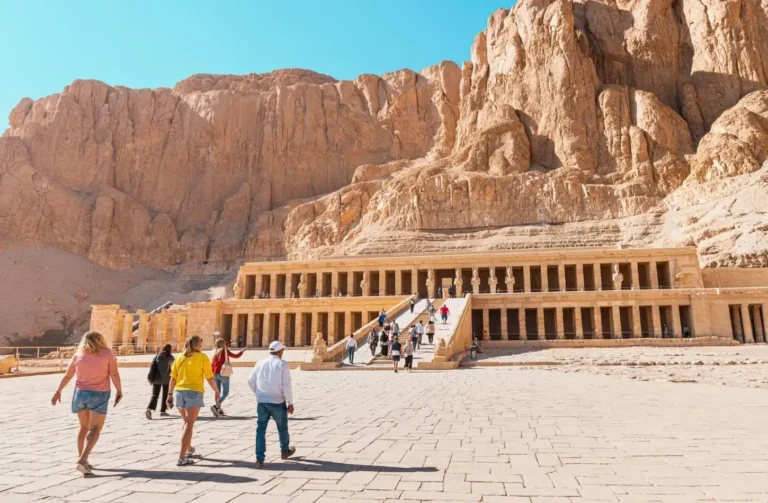
You see the layout that makes Luxor easy to read from above. The Ministry says the Valley of the Kings holds the burials of New Kingdom rulers of the Eighteenth, Nineteenth and Twentieth Dynasties, in a dry river valley across the Nile from ancient Thebes. Hatshepsut’s temple at Deir al-Bahari, built around 1473 to 1458 BC, sits on the west bank directly across the river from Karnak.
Karnak is on the east bank, and the Ministry puts Luxor Temple about three kilometres to its south. From the air the Nile separates the farmland and cities of the east from the desert hills of the west. The wind sets the route, so no one can promise a pass over a particular temple.
What time does the flight start?
Very early. Flights begin around sunrise, so you will be awake long before it. Weather Spark gives Luxor a January sunrise of about 6:33 to 6:37. Sunrise moves through the year, so the clock time of the flight moves with it. Ask what time your booking collects you on your own date.
No official source we opened gives a flight length or a pick-up time, so your booking confirmation sets both. Plan on a dark start, a flight at first light, breakfast afterwards and a return to the hotel in the morning. The west bank sites are ready for you once you land: the Ministry lists the Valley of the Kings and Hatshepsut’s temple as open from 6:00 to 17:00.
When is the balloon season in Luxor?
The season is mostly the cooler months, and 2026 had a summer pause. Egypt Today reported that the Civil Aviation Authority and the Egyptian Airports Company announced a suspension of commercial flights from 1 June to 30 August 2026, citing high summer temperatures and their effect on operating conditions. It says flights over the west bank resumed on 15 September 2026, after three months.
The same report calls the pause the first in the 38 years of ballooning at Luxor, and also says it was implemented annually at the request of the sector, which are two statements that do not fit together. Do not assume the 2027 summer schedule. Ask when you book which dates are on the schedule. For temperatures month by month, see when to visit Egypt.
How much does the weather decide?
Wind is the deciding factor, then dust and cloud. Egypt Today reported that on 13 March 2026 the Civil Aviation Authority held flights over the west bank after warnings of weather fluctuations and strong winds in the early morning. In March 2020 Egypt Independent reported that increased wind speeds kept flights on the ground for four consecutive days, with heavy cloud also limiting visibility.
Spring adds dust to the list. The Government of Canada says sand and dust storms can occur in spring, reduce visibility and affect flights, and the Khamsin wind is most common in April. Build slack into your plan: keep a spare morning in Luxor and do not put the balloon on the last day before a flight home.
How windy is Luxor, month by month?
Winter is the calmest season on the daily average, and the wind rises through spring and summer. Weather Spark gives these average hourly wind speeds for Luxor. They cover the whole day, so a dawn reading can be lower, and the table shows the season, not a forecast.
| Month | Average wind (mph) | Month | Average wind (mph) |
|---|---|---|---|
| January | 7.8 | July | 10.0 |
| February | 8.3 | August | 10.1 |
| March | 8.8 | September | 9.6 |
| April | 8.9 | October | 8.0 |
| May | 9.4 | November | 7.5 |
| June | 10.3 | December | 7.5 |
Weather Spark calls June the windiest month and November and December the calmest. It also marks 22 April to 28 September as the windier part of the year, with averages above 8.9 mph.
When does the sun rise through the year?
The flight clock moves by nearly two hours across the year. Weather Spark’s 2026 figures for Luxor put the earliest sunrise at 5:19 on 23 April and the latest at 6:55 on 29 October, so check the time for your own date when you book. In December the sunrise runs from 6:18 on the 1st to 6:35 on the 31st. Your pick-up is hours before these times.
What is the ride itself like?
It is a quiet flight. The Egypt Today reports describe flights from sunrise over the archaeological and tourist sites on both sides of the city. The sources we opened give no flight length, basket size or boarding details, so those come with your booking. Ask for them in writing when you reserve.
Expect to be on your feet and to follow the crew’s instructions for boarding and landing. If anyone in your group has a back, hip or knee problem, or is pregnant, mention it at the time of booking so the plan can fit. Bring a camera strap or a phone lanyard, because you will want both hands free at times.
Is the sky clear enough for the view?
Usually, yes. Weather Spark’s cloud data puts the share of clearer skies in Luxor at 81% in January and 76% in December, the cloudiest month. It reaches 95% in June and 96% in September, the clearest month.
Rain is almost absent. The WMO records at most 1.6 mm in any month and no more than 0.5 rain days a month, and Weather Spark records wet days 0% to 1% of the time with monthly totals of 0.0 inches. Weather Spark also says muggy conditions occur about 1% of the time year-round. The practical risk is wind and the occasional dust day, not rain.
Which season is the most comfortable?
The cool season. Weather Spark defines it as about 2.8 months from 1 December to 23 February, with average daily highs below 78 °F (about 26 °C). January is the coldest month, with an average low of 46 °F and an average high of 72 °F.
The hot season runs about 4.8 months from 6 May to 1 October, with highs above 98 °F (about 37 °C). July is the hottest month, with an average high of 105 °F and a low of 79 °F. That is why the 2026 summer pause fell between June and August, and why a winter or shoulder-season flight is the comfortable choice for most visitors.
How cold is it at dawn, and what should you wear?
Dress for a winter morning, even if the day turns hot. Luxor’s 1981-2010 mean low is 7.8 °C in December, 5.9 °C in January and 7.8 °C in February, according to the World Meteorological Organization (WMO) World Weather Information Service, with data from the Egyptian Meteorological Authority. Wikipedia’s climate table lists record lows of -0.3 °C in January and -1.0 °C in February. Weather Spark’s modelled January average low is about 46 °F, which is nearly 8 °C and warmer than the WMO mean.
In March the mean low rises to 11.8 °C, and it reaches 21.2 °C in May. Wear layers you can remove once the sun is up, closed shoes and a hat. Bring water, and ask your booking whether breakfast follows the flight. Pack sunscreen too, because the sun is strong by the time you reach the west bank sites.
How does the morning run, step by step?
- You are collected from your hotel in the dark, well before sunrise. The exact time is in your booking confirmation.
- The flight goes up around first light, when the air is usually calmest (Egypt Today describes take-off at sunrise).
- If the wind is wrong, the flight is held and you move to another morning. Weather Spark’s monthly averages show winter as the calmest season.
- After landing you return to the hotel for breakfast, or ask your booking whether breakfast is included.
- The west bank sites open at 6:00, so the Valley of the Kings and Hatshepsut’s temple are available the same morning (Ministry of Tourism and Antiquities).
What should you bring?
Keep it short. Bring a warm layer for the dark start, a hat, sunglasses and sunscreen for the west bank afterwards, closed shoes, a bottle of water, and your phone or camera on a strap. Leave bags and loose items at the hotel where you can.
Luxor is dry, with no more than 0.5 rain days a month according to the WMO, so a rain jacket is not needed. A thin scarf is useful for both the cold air at dawn and the sun later.
How do you fit it into a Luxor day?
Keep the rest of the day light and the schedule loose. A sunrise flight, then breakfast, then the Valley of the Kings, makes a long morning. Our 10-day itinerary fits the west bank on day 5 and keeps the day flexible for this reason.
Karnak is open 6:00 to 17:00 and Luxor Temple 6:00 to 20:00 (Ministry), so both can wait until the afternoon or evening. If the wind holds the flight, you simply start the west bank earlier and try again on your spare morning. To book the flight, see our Sunrise Hot Air Balloon over Luxor tour, or use our trip planning page for help with dates.
Who is a balloon flight not for?
It does not suit travellers who dislike a pre-dawn start or who need a fixed schedule, because wind can move the flight to another morning. It also needs a plan for dust days in spring. Schedule the flight on your first Luxor morning with a spare morning later. Anyone with a mobility concern should mention it at the time of booking.