

Short answer: Choose a Nile cruise ship by route, number of nights, cabin position and temple timetable, not by a star label alone. Most cruises run 3 to 7 nights, mainly between Luxor and Aswan, and October to February is the preferred season. Check what the price includes, because temple entry fees are set separately.
Key facts
- Typical length
- 3 to 7 nights, most between Luxor and Aswan (Experience Egypt)
- Classic route
- Most modern cruises run from Luxor to Aswan (Wikipedia)
- Preferred season
- October to February, when temperatures are more tolerable (Wikipedia)
- Locks
- Open October to mid-April; from about mid-April passengers change boats around the lock (Wikipedia)
- Temple hours
- Philae 7:00 to 16:00; Kom Ombo 7:00 to 21:00 (Ministry, checked 29 October 2026)
- Health
- Norovirus outbreaks are not uncommon on cruise ships (US CDC)
What should you compare first?
Compare the route, the number of nights, the cabin and the temple timetable before you look at any label. A star rating tells you little unless you also know the cabin size, the deck and what the price includes. We could not open an Egyptian government page that sets out the grading rules, so we do not describe them.
The sections below follow the order in which the choice usually narrows: ship type, route and nights, cabin, temples, season, then the price list.
Related tripsCompare 29 Nile cruise shipsSailing days, cabins and prices for every ship.What types of Nile boat are there?
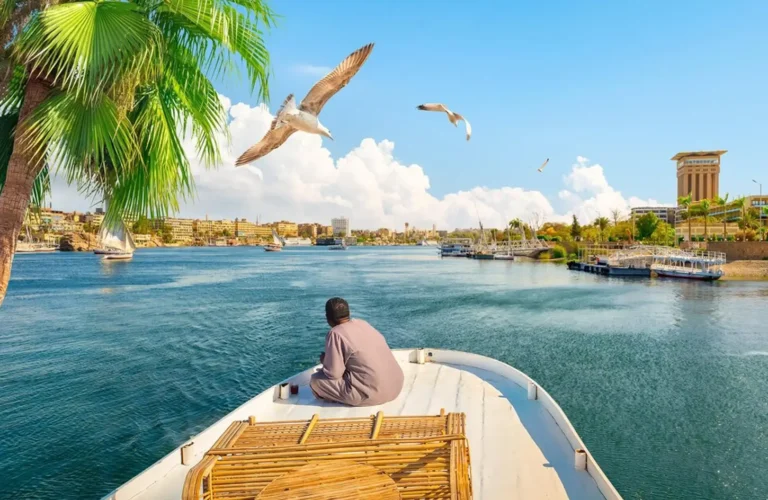
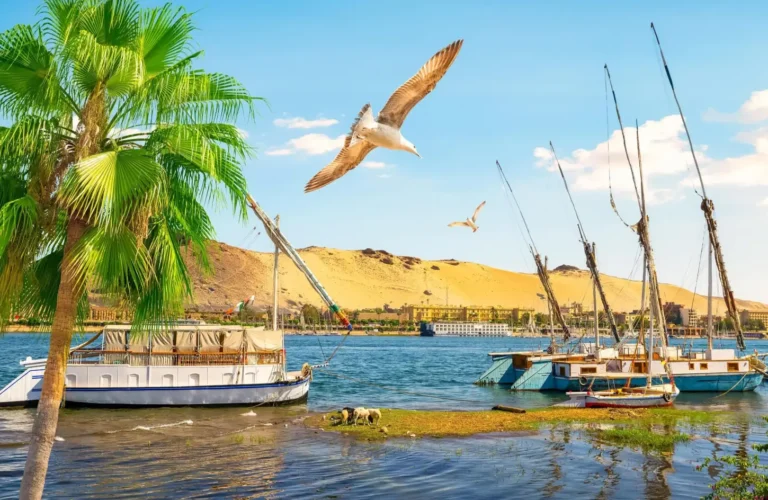
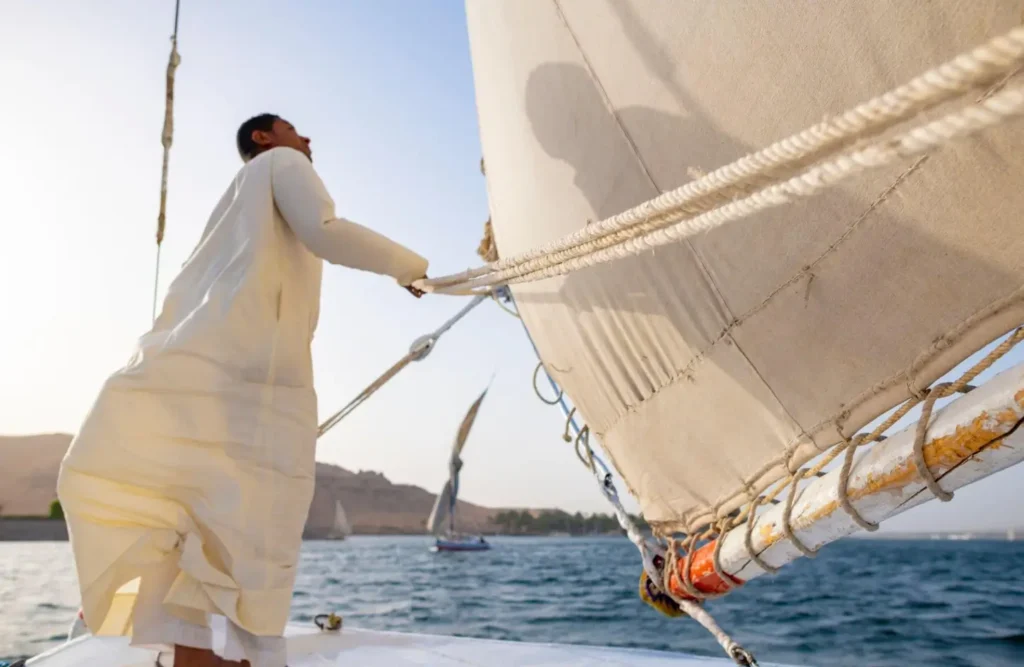
Wikipedia lists four types. Modern cruise ships are larger vessels that function as floating hotels. The dahabeah is a motorless passenger sailboat from the 19th century, typically with six to ten cabins. The felucca is a traditional sailboat, and overnight trips may mean sleeping on deck. Steamers were introduced in 1869, when they replaced sailing dahabeas and cut the trip to about three weeks.
Wikipedia puts the number of cruise ships on the Nile above 300, so the same label covers many different boats. Our dahabiya guide covers the small sailing option. A felucca has no private cabins in the sense a ship does, so it belongs in a different comparison from the one on this page.
Which route and how many nights?
Luxor to Aswan is the classic route. Experience Egypt says most ships run three to seven nights, mostly between Luxor and Aswan in either direction. Wikipedia adds that original Nile cruises were 20 to 21 day trips from Cairo to Aswan, with a 3 to 4 day stop in Luxor, and that those itineraries are no longer offered for security reasons. It notes that a few cruises have resumed the long Cairo-to-Aswan route, without giving a date.
Some longer cruises also visit Dendera, a northern town, according to the same page. Short cruises on Lake Nasser visit the Nubian monuments, including Abu Simbel, and are a separate product from a Luxor to Aswan sailing. We found no official source that sets a minimum number of nights, so count the temples in the plan and divide your days accordingly.
The old pace shows why modern cruises are short. Wikipedia says early trips depended on the wind, and a typical one started in Cairo in October, reached Aswan, and returned in January. Today a sailing is measured in nights, not months, so every temple stop competes for the same few days.
What cabin differences matter?
Cabin size, light and position matter more than the label. We found no official source that sets cabin sizes, so ask for the numbers of the ship you are booked on, and compare them in square metres, not adjectives. Ask these questions before you pay:
- Is the cabin double or twin, and on which deck?
- Does it have a river-facing window or a balcony, and does the window open?
- Is there a triple cabin for a family, and what does a single traveller pay?
- Does the ship have a pool, a spa and a gym?
- Where is the cabin relative to the engine room, the sun deck and the dining room?
Ships often moor side by side at the quay, so a river-facing window can look onto the next ship instead of the water. Ask for the deck plan, find your cabin number, and check what is above, below and beside it. Our guide to Nile cruise cabin types explains the labels.
What should the price include?
Inclusions drive price differences more than the ship does. Sightseeing is often priced separately, so ask in writing:
- Is an Egyptologist guide at the sites, or the ship’s group guide?
- Are site entrance fees included?
- Are drinks, tips and optional excursions extra?
- Which meals are on board, and which are not?
Entry fees are set by the Ministry of Tourism and Antiquities, so two honest quotes should agree on them. The table lists what to check on each Ministry page we opened on 29 October 2026. The Ministry publishes the figures in the local currency only, so we show none.
| Site | Foreign adult ticket | Note |
|---|---|---|
| Karnak (inclusive ticket) | Inclusive ticket | Mut Temple is a separate ticket |
| Valley of the Kings | Site ticket | Over sixty tombs |
| Edfu | Temple ticket | Horus temple |
| Kom Ombo | Temple ticket | Two sanctuaries |
| Philae | Island temples ticket | Temple panorama ticket is separate |
| Abu Simbel | Standard ticket, higher on 22 Feb and 22 Oct | Higher on the sun-alignment dates |
For the broader question of cruise versus land tour, see Nile cruise vs land tour.
How does the timetable decide which temples you see?
Opening hours decide the visit, not the ship’s brochure. The Ministry pages give Philae 7:00 to 16:00, Edfu a 17:00 close and Kom Ombo 7:00 to 21:00. A ship that reaches Edfu or Philae late may miss it, while Kom Ombo can be visited into the evening.
Edfu is dedicated to Horus. Construction began in 237 BC under Ptolemy III and was completed in 57 BC under Ptolemy XII, about 180 years later, according to the Ministry. The temple was buried under settlement debris for millennia, which helped preserve it, and the French archaeologist Auguste Mariette uncovered and restored parts of it in 1860.
Kom Ombo is dedicated to the crocodile god Sobek and to Horus the Elder (Harwer). Its two parallel passages lead to two sanctuaries, one for each god, and a 2nd-century AD carving there is believed to show surgical instruments. Philae’s monuments were moved to nearby Agilkia in the 1960s UNESCO Nubia Campaign, after the Aswan High Dam flooded the original site.
When you compare itineraries, check the arrival time at each temple, not only its name. A visit that starts an hour before closing is a hurried one.
What do the Luxor stops add to the plan?
Luxor holds the two longest visits of most cruises, so check how long the plan gives each. Karnak opens at 6:00 and closes at 17:00, according to the Ministry. The Great Hypostyle Hall has 134 columns, most of them 15 metres tall and the central twelve 21 metres. The larger obelisk, erected by Hatshepsut, is almost 30 metres tall and weighs over 300 tons.
The Valley of the Kings, on the west bank across from ancient Thebes, has over sixty tombs and is open from 6:00 to 17:00. A cruise that gives you a free morning in Luxor lets you start at opening, while a cruise that sails at dawn may not. Ask which hours the Luxor days actually use.
Is Abu Simbel part of a Nile cruise?
Usually it is a separate add-on, not a stop on the river. Wikipedia says short cruises on Lake Nasser visit the Nubian monuments, including Abu Simbel. A Luxor to Aswan sailing does not end at the temple, so ask whether a visit is in the plan and how you will get there.
The Ministry says Abu Simbel was built around 1264 BC by Ramesses II and moved in 1968 because the Aswan High Dam threatened to submerge it. On 22 February and 22 October, sunlight crosses the main hall and lights the innermost statues, and the foreign adult ticket is higher on those two dates than on other days. If your dates fall on either day, ask for it in writing.
What happens at the Esna lock?
Allow for waiting. Wikipedia’s Esna page says cruise ships heading upstream can be held up for hours while passing the lock system at the barrage. One barrage bridge there was built by the British in 1906, and the Electricity Bridge dates from the 1990s. That is a general warning and not a timetable, so ask the seller how long the passage usually takes on your sailing.
Wikipedia says the Nile locks are open from October to mid-April, and that from about mid-April they close to manage water levels, so passengers leave the boat on one side of the lock and transfer to another boat on the other side. We found no official page on lock dates, so ask the seller how a sailing outside the cool months handles it.
When should you sail?
Wikipedia says the preferred season is October to February, when temperatures are more tolerable. From October to mid-April, daytime temperatures are cooler and the locks are open. We found no official source for peak-season price changes, so ask for rates for your exact dates.
The WMO World Weather Information Service, which publishes Egyptian Meteorological Authority data, gives these 1981 to 2010 mean daily maximums and minimums in degrees Celsius for the shoulder months.
| Month | Luxor high / low | Aswan high / low |
|---|---|---|
| October | 35.3 / 18.4 | 35.7 / 20.8 |
| November | 29.0 / 12.3 | 29.0 / 15.6 |
| February | 25.1 / 7.8 | 24.8 / 11.0 |
| March | 29.5 / 11.8 | 29.4 / 14.9 |
| April | 35.3 / 16.9 | 35.2 / 19.9 |
November, February and March keep the daytime highs near 30 or below, with cooler nights. October and April reach the mid-30s, so the sun deck is a morning and evening space.
Keep readingDahabiya or cruise ship: how they differ on the Nile, routes and seasonA dahabiya is a shallow-bottomed Nile passenger boat with two or more sails, a type that...What do you compare between two ships?
| Question | Why it matters |
|---|---|
| Which deck and where on the deck? | Noise, window height, views |
| Does the window open? | Fresh air and a river view you can use |
| Where does the ship moor? | Side-by-side berths change the view |
| What time does it reach each temple? | Closing times of 16:00 and 17:00 |
| Are entry fees in the price? | Fees on the Ministry list add up |
| How many nights and which direction? | Sets how many temples fit |
What about health on board?
The US CDC says river cruise conditions can spread infectious disease, norovirus outbreaks are not uncommon on cruise ships, and good hand hygiene helps. It also advises against swimming or wading in the Nile because of the risk of schistosomiasis. Use the ship’s pool if it has one.
Who is a big ship not for?
A larger ship suits travellers who want a fixed schedule and shared excursions. It does not suit anyone who wants a small group or a flexible pace. Those travellers should look at a dahabiya or a land tour. If you want help matching a ship to your dates, use our trip planner.