

Short answer: A Nile cruise from Luxor to Aswan keeps your bed on one ship while it passes Edfu and Kom Ombo. A land tour uses hotels, adds Cairo and Abu Simbel more easily, and lets you set the pace. Luxor is about 220 km north of Aswan in a straight line.
Key facts
- Usual cruise route
- Most modern Nile cruises start at Luxor and run to Aswan (Wikipedia, secondary)
- Distance Luxor to Aswan
- Luxor is about 220 km north of Aswan in a straight line (Wikipedia)
- Temple towns between the cities
- Esna, Edfu and Kom Ombo (Wikipedia places Esna about 55 km south of Luxor; the Ministry says Edfu and Kom Ombo lie a short distance north of Aswan)
- Edfu temple
- Built between 237 BC and 57 BC, dedicated to Horus (Ministry of Tourism and Antiquities)
- Kom Ombo temple hours
- 7:00 to 21:00 daily per the Ministry, checked 28 October 2026
- Entry tickets, foreign adult
- Karnak, Edfu, Philae and Abu Simbel are priced on the Ministry pages (checked 29 October 2026)
What is the route of a Nile cruise between Luxor and Aswan?
Most modern Nile cruises start at Luxor and sail to Aswan, or the reverse. Wikipedia notes that cruises from Cairo to Aswan once ran but ended over security concerns, and that a few short cruises on Lake Nasser reach the Nubian monuments including Abu Simbel. Between Luxor and Aswan the river passes three temple towns.
- Esna: the Temple of Khnum, which sits about 9 metres below street level (Wikipedia).
- Edfu: the Temple of Horus, begun under Ptolemy III in 237 BC and finished under Ptolemy XII in 57 BC (Ministry of Tourism and Antiquities).
- Kom Ombo: a double temple for Sobek and Haroeris, also known as Horus the Elder (Ministry of Tourism and Antiquities).
The two ends of the river stretch are set by different sources. Wikipedia puts Esna about 55 km south of Luxor, the Ministry of Tourism and Antiquities places Esna and Edfu on the west bank of the Nile, and the Ministry’s Aswan page says Edfu and Kom Ombo lie a short distance north of Aswan. Luxor itself is about 220 km north of Aswan in a straight line. We found no official road timings, so ask any driver for a written plan with a time for each stop.
Related tripsCompare 29 Nile cruise shipsSailing days, cabins and prices for every ship.How do a Nile cruise and a land tour compare?
The main difference is where you sleep and who sets the timetable. The table lists the points that decide most choices.
| Point | Nile cruise | Land tour |
|---|---|---|
| Where you sleep | One ship, cabin stays the same | Hotels in each city |
| Typical route | Luxor to Aswan or back, with Edfu and Kom Ombo on the way | Any route: Cairo, Luxor, Aswan, Abu Simbel, Red Sea |
| Pace | Set by the ship’s timetable; sightseeing stops fit around it | Set by you and your guide; easier to add or drop a site |
| Packing and unpacking | Once | At each hotel change |
| Between Luxor and Aswan | You sail; the ship passes Edfu and Kom Ombo | About 220 km in a straight line (Wikipedia); by road or rail, with a stop at each temple town |
| Cairo and the Giza pyramids | Not on the usual cruise route; add separately | Easy to include |
| Main cost drivers | Ship class, cabin type and position, number of nights, season, what sightseeing is included, drinks and extras | Hotel class, private or group transport, domestic flights, guide, number of days, season |
| Entry tickets | Same Ministry prices as on land | Same Ministry prices as on a cruise |
Prices depend on all of the cost drivers above, so we do not quote a general figure. Compare quotes with the same inclusions in writing, as our booking checklist explains.
Which sites do you see on each option?
Both options can cover the same temples. Karnak, the Valley of the Kings and Hatshepsut’s temple all open at 6:00 and close at 17:00, and Luxor Temple stays open until 20:00, according to the Ministry of Tourism and Antiquities. In Aswan, Philae opens from 7:00 to 16:00 and Abu Simbel from 6:00 to 17:00. Edfu opens at 6:00 or 7:00 depending on the day and closes at 17:00. Kom Ombo opens from 7:00 to 21:00. Hours can change, so check the ministry page near your date.
Abu Simbel is the real difference. It lies about 300 km south of Aswan, according to the Ministry of Tourism and Antiquities, so it is not one of the stops between Luxor and Aswan. Most itineraries treat it as a separate day trip. UNESCO says the Ramses II temples were cut into more than a thousand blocks of roughly 30 tons each and rebuilt in an artificial cliff about 64 m above the old site and 180 m inland, with the site reopening on 22 September 1968. The Ministry gives 1979 as the year of its World Heritage inscription.
Who does a Nile cruise suit?
A cruise suits travellers who want to unpack once, eat on board and sail between the Luxor and Aswan temples without road transfers. It suits couples, small groups and families who prefer a fixed base. It also suits anyone who would rather not spend hours in a car between temples.
It does not suit people who dislike early starts or fixed meal times, because sightseeing is built around the ship’s schedule. It is also a poor fit if you want Cairo, the pyramids and the Red Sea in the same trip without extra transfers. Travellers who worry about shared dining and hygiene should note that the CDC mentions a norovirus risk on Nile cruises and recommends good hand hygiene.
Who does a land tour suit?
A land tour suits travellers who want to build their own route: more days in Cairo, a stay in Luxor on both banks, then Aswan and Abu Simbel. It lets you slow down for a site you like and drop one you do not. It suits people who want hotels with a fixed address or a Red Sea beach at the end.
It does not suit travellers who dislike changing hotels, who dislike long days on the road, or who are uneasy about driving distances. Luxor and Aswan are about 220 km apart in a straight line (Wikipedia), and a road day with temple stops in between is a long one. GOV.UK advises against driving outside main cities and resorts at night.
What health points apply on the river?
Two food and water points matter on a cruise. The CDC says cooked meat and vegetables on Nile cruise ships are generally safe to eat, and it advises against swimming or wading in freshwater such as the Nile because of schistosomiasis. Use the ship’s pool and wash your hands before meals.
How long does the drive take once you add the stops?
Longer than the map suggests. Luxor is about 220 km north of Aswan in a straight line (Wikipedia), and a day by road that includes Esna, Edfu and Kom Ombo needs a visit and a drive at each. A ship covers the same ground while you are on board, so the road day disappears.
The train is the other way to cover the distance. Seat61, updated on 14 September 2026, lists daily trains calling at both Luxor and Aswan, and by our reading of its southbound table the daytime services take about three hours between the two. It says foreigners pay higher prices than Egyptians, so check the current fare and ticket office rules before you plan around it.
What do the main sites cost to enter?
Entry fees are the same whichever way you travel, so they do not decide the choice. The Ministry lists foreign adult and student prices in the local currency only, which we checked on 29 October 2026, so we show no figures. The table shows which tickets exist.
| Site | Foreign adult | Foreign student |
|---|---|---|
| Karnak | Listed | Listed |
| Luxor Temple | Listed | Listed |
| Edfu | Listed | Listed |
| Kom Ombo | Listed | Listed |
| Philae | Listed | Listed |
| Abu Simbel | Listed | Listed |
Abu Simbel costs more for adults and students on 22 February and 22 October, the two days when sunlight reaches the inner statues. Whatever you book, ask in writing whether entrance fees are inside the quote.
What is the Esna lock, and does it change a cruise?
It is a lock at the Esna barrage, on the west bank about 55 km south of Luxor, and a Luxor to Aswan sailing passes it. Wikipedia’s Esna page says ships, including Nile cruisers, can be held up for hours while they negotiate the lock system. It says the Temple of Khnum, 200 m from the river and partly excavated, survives mainly as its front hall. We found no official transit time, so ask your ship how it plans for the lock and whether a temple visit is included.
How did Nile cruising get to where it is?
Wikipedia says Thomas Cook hired two steamboats in 1869, which cut the trip to about three weeks, and became the appointed agent for all Nile passenger traffic in 1870. The original itinerary ran 20 to 21 days from Cairo to Aswan, with a three to four day stop in Luxor. More than 300 ships now work the river, and October to February is the preferred season because it is cooler.
Is there a third option between ship and car?
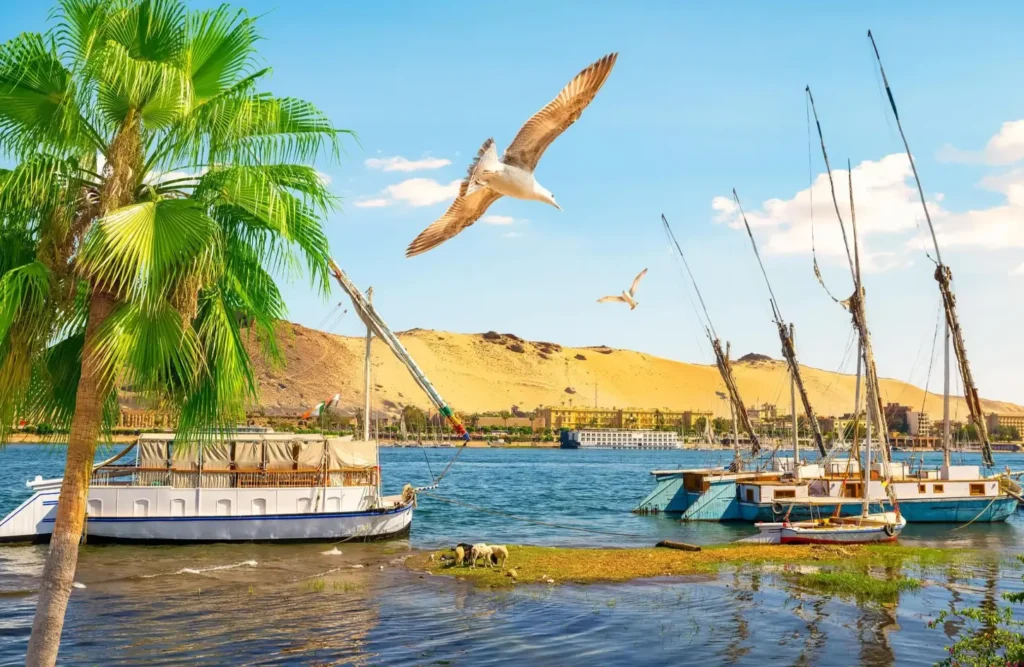
Two smaller boats are worth knowing. Wikipedia describes the dahabeah, a 19th-century motorless sailboat, often towed by rowboats when the wind failed, typically with 6 to 10 cabins. It also describes the felucca, a traditional sailboat, where overnight trips may mean sleeping on deck with the crew cooking. Our dahabiya guide covers the modern version. The train is another way to cover the distance, and Wikipedia says a daily sleeper train runs Alexandria, Cairo, Luxor and Aswan. Check the current timetable and book seats before you commit.
What do the temple stops add up to?
Whichever way you travel, the temples between Luxor and Aswan span about 2,000 years. The Ministry pages give the dates. Karnak holds the Great Hypostyle Hall, with 134 columns, of which the central 12 rise 21 m. The Valley of the Kings holds over sixty tombs cut for rulers of the 18th to 20th Dynasties, roughly 1550 to 1069 BC. Edfu was built between 237 BC and 57 BC, and Philae’s main temple of Isis was begun by Ptolemy II Philadelphus.
Philae is also the stop that explains the dam. Its buildings were moved to the higher island of Agilkia between 1972 and 1979 as part of the UNESCO campaign, which saved 22 monuments and complexes between 1960 and 1980. Those facts apply to a cruise passenger and a land traveller alike, so they do not separate the two options. What separates them is how much time you spend getting between the sites.
Which mistakes make the comparison unfair?
- Comparing a cruise quote that includes meals with a land quote that does not.
- Leaving out Abu Simbel from one side. It is a separate trip from Aswan either way.
- Assuming every ship stops at Esna or Dendera. Some longer cruises visit Dendera, but not all.
- Ignoring time of year. The preferred cruise season is October to February.
- Forgetting that a land tour adds domestic transfers and a hotel change in each city.
How do you decide in five steps?
- Count the nights you have, and compare them with the 3 to 7 nights Experience Egypt gives for Luxor to Aswan sailings.
- Decide whether Cairo and Giza must be in the same trip.
- Decide whether you accept a fixed timetable for meals and sightseeing.
- Get two quotes for the same dates with the same inclusions, in writing.
- Check the government advice for your passport and the dates of travel.
What does this comparison leave out?
We do not quote prices, because they depend on ship class, hotel class, season and what is included. We could not confirm current sailing timetables or Esna transit times from an official source. Rail timetables and domestic flight options also need a check on your dates.
Can you combine both?
Yes. A common pattern is Cairo and Giza by road, a flight to Luxor, a cruise to Aswan, and Abu Simbel as a day trip from Aswan. Our 7 days in Egypt itinerary shows a land version of that week. Ship pages are listed under Nile cruises.