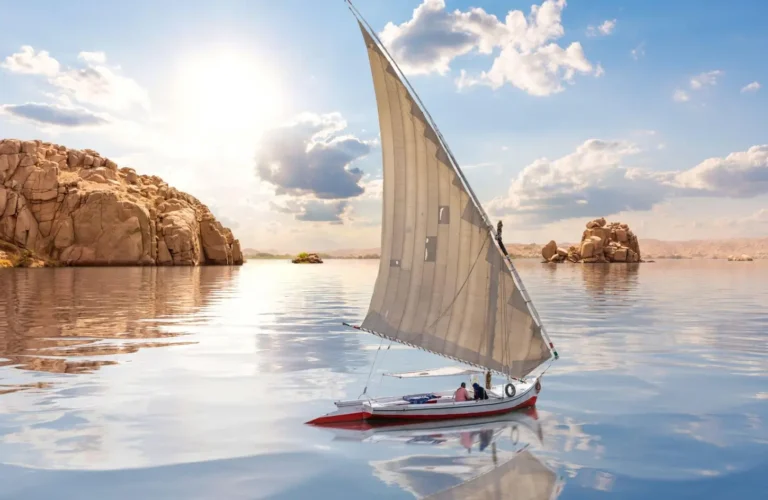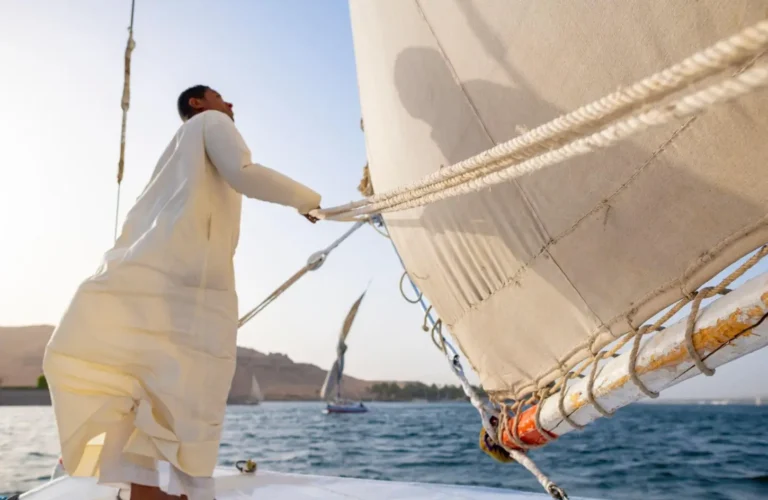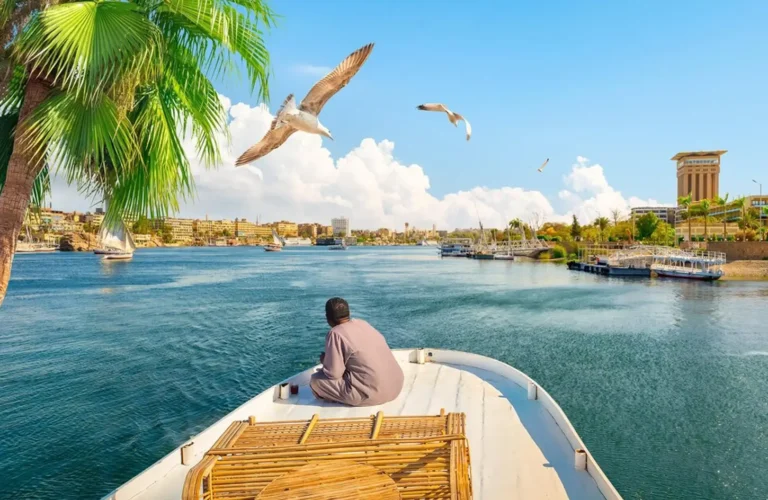


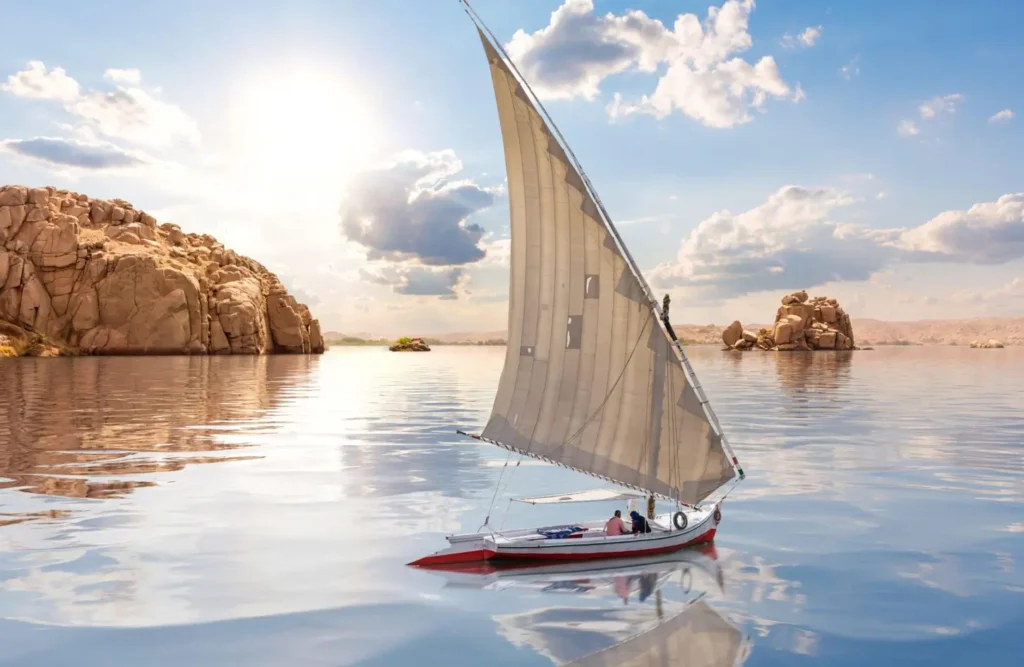
Short answer: A dahabiya is a shallow-bottomed Nile passenger boat with two or more sails, a type that has existed for thousands of years. Modern tourist boats are usually towed by diesel tugboats and carry a generator, and they serve the river between Luxor and Aswan. Ask any boat how it moves when the wind drops.
Key facts
- What it is
- Usually a shallow-bottomed, barge-like boat with two or more sails (Wikipedia)
- Engines
- Modern tourist dahabiyas lack a propeller motor, are towed by diesel tugboats and carry a diesel generator (Wikipedia)
- Where it runs
- Between Luxor and Aswan, about 220 km of river (Experience Egypt, Wikipedia)
- River stops
- Esna, El Kab, Edfu, Gebel el-Silsila and Kom Ombo (Ministry, Wikivoyage)
- Season
- Nile cruising is preferred October to February (Wikipedia)
- Not found
- No official cabin count, itinerary length or boat registry
What is a dahabiya?
A dahabiya, also spelled dahabeah, is a passenger boat used on the Nile. Experience Egypt calls a dahabiyya a two-masted sailing boat that can be chartered from Aswan to Lake Nasser. Wikipedia describes it as usually shallow-bottomed and barge-like with two or more sails, and says similar craft are shown on the walls of pharaohs’ tombs, so the type has existed in one form or another for thousands of years. The name comes from the Arabic word for gold and refers to the gilded state barges of medieval Muslim rulers of Egypt.
Today the word describes a small tourist boat modelled on that tradition. Experience Egypt, the official Egypt tourism site, says luxury dahabeyas operate between Aswan and Luxor.
Related tripsCompare 29 Nile cruise shipsSailing days, cabins and prices for every ship.How did dahabiyas become tourist boats?
Until the 1870s the dahabiya was the standard way for tourists to travel the Nile. Wikipedia quotes Donald Reid’s figures for 1858: a forty-day round trip from Cairo to Luxor and a fifty-day trip to Aswan and back. Those sums were nineteenth-century prices in another currency, so they say little about what a modern dahabiya trip costs. In 1847, Sir John Gardner Wilkinson’s handbook described the work of hiring one: provisioning it, clearing it of bugs and rats, overseeing the boatmen and having it repainted.
Thomas Cook and Son then introduced the steamboat and organised methods that turned a three-month voyage into a 28-day sightseeing tour. By 1900 trains were competing with steamboats, and dahabiyas were left to the wealthiest and most leisured travellers. The modern tourist boat keeps the shape and the slow pace, and the planning is done for you.
How is a dahabiya different from a cruise ship?
The main differences are propulsion, size and where the boat can stop. The table sets out what the sources we opened say, and the question to ask for each point.
| Point | What the sources say | What to ask |
|---|---|---|
| Propulsion | Modern dahabiyas lack a propeller motor and are towed by diesel tugboats (Wikipedia) | How does the boat move when there is no wind? |
| Electricity | An onboard diesel generator supplies power (Wikipedia) | Is the generator running at night? |
| Guests | No official cabin count found | How many cabins and how many guests are on this boat? |
| Pace | Sail boats move slowly by nature; no official timetable found | How many hours a day is the boat moving? |
| Stops | Temple and quarry stops lie along the river (Ministry) | Which stops and entrance fees are in the price? |
For the other side of the comparison, see how to choose a Nile cruise ship. Cabin counts differ from boat to boat, so ask for the exact figure of the boat you choose.
Does a dahabiya really sail?
Partly. Wikipedia says modern tourist dahabiyas lack a motor-driven propeller, are towed by diesel tugboats and carry a diesel generator for electricity. That does not rule out sails, and we found no official source that says how many hours a day any boat sails or is towed.
Before you book, ask how the boat moves when there is no wind, whether a tow or support boat is used, and how that affects your timetable. A boat that is towed keeps to a schedule. A boat that waits for wind may not.
What stretch of river does a dahabiya cover?
The river between Luxor and Aswan, about 220 km according to Wikipedia’s Luxor article. Wikivoyage places Esna 54 km south of Luxor, Edfu 53 km beyond Esna and Kom Ombo 65 km south of Edfu. Wikipedia puts Kom Ombo 50 km north of Aswan. Experience Egypt says dahabeyas operate between Aswan and Luxor.
We found no official source on usual boarding points, itinerary lengths or sailing days. Boarding point, stops and days vary from boat to boat, so compare itineraries line by line rather than assuming they match.
When is the sailing season?
We found no official dahabiya season. Wikipedia calls October to February the preferred Nile cruising season, with more tolerable temperatures, and says the river locks are open from October to mid-April. Confirm dates with your booking contact. For wider weather information see when to visit Egypt.
What should you ask before booking?
- How many cabins and how many guests are on this boat?
- Does the boat have an engine, a tow or a support boat?
- Where do you board, and where do you disembark?
- Which meals, excursions and entrance fees are included, and which nights in hotels?
- What happens if the wind stops?
- Is the boat shared with other guests, or can one group charter it?
Ask for the answers in writing, and compare two boats on the same list. A lower total with more blanks is not cheaper until the blanks are filled.
What about health and safety?
Do not swim or wade from the boat: the US CDC links the Nile and irrigation canals to schistosomiasis, and notes that river cruises can spread infections such as norovirus.
Who is a dahabiya not for?
It does not suit travellers who want a pool, spa or evening entertainment, or a rigid timetable. It also does not suit anyone who dislikes a slow pace with little to do between temple stops. For a larger ship, compare it with our Nile cruises, and use the trip planner if you want a dahabiya built into a wider Egypt itinerary.
What do the stops on the river offer?
Five places come up on this stretch: Esna, El Kab, Edfu, Gebel el-Silsila and Kom Ombo. The table gives the Ministry of Tourism and Antiquities hours for four of them (checked 29 October 2026), and the ticket prices stay on the Ministry pages because they are published in the local currency only and the Wikipedia description for Esna, with its bank and governorate from the Ministry news page.
| Stop | Hours listed | Foreign adult ticket | What the source says |
|---|---|---|---|
| Esna | Not listed in our sources | Not listed | In Qena governorate on the west bank (Ministry); about 55 km south of Luxor, with the Temple of Khnum about 9 m below street level (Wikipedia) |
| El Kab | 7:00 to 17:00 daily | Listed on the Ministry page | Ancient city of Nekhbet; temple remains, city walls and decorated New Kingdom tombs, including that of Ahmose, son of Abana |
| Edfu | 6:00 or 7:00 to 17:00, depending on the day | Listed on the Ministry page | Temple of Horus, begun in 237 BC and finished in 57 BC |
| Gebel el-Silsila | 7:00 to 16:00 | Listed on the Ministry page | Sandstone quarries on both banks, worked from the Middle Kingdom into the 20th century; the rock-cut Speos of Horemheb |
| Kom Ombo | 7:00 to 21:00 | Listed on the Ministry page | A dual temple with one half for Sobek and one for Horus the Elder |
Whether entry tickets are in your price depends on the booking. Ask the same question of every boat you compare, and ask which of these stops the boat actually visits, because a small boat does not have to stop at all of them.
Why does boarding at Esna matter?
It decides how much of your trip is spent on the river rather than waiting. Wikipedia’s article on Esna says cruisers heading from Luxor towards Aswan can be held for hours at the lock system at the town. That is an old problem on this stretch, and it affects every kind of boat.
No official source we opened says why a boat should board at Esna, so we do not claim it. Ask where you board and, if it is not Luxor, whether the road transfer is included and how long it takes.
What is Gebel el-Silsila, and why is it on the route?
It is the quarry that supplied stone for many of Egypt’s major temples. The Ministry page says there were more than a hundred quarries on both banks, that tool marks and workers’ inscriptions survive, and that 32 rock chapels were cut into the cliff for New Kingdom officials, mostly from the time of Hatshepsut and Thutmose III.
Two temples of Horemheb once stood on the west bank. Only the Speos of Horemheb survives, dedicated to seven deities. The site is open from 7:00 to 16:00 every day. You walk along the quarry faces rather than through a large temple hall, which suits travellers who like landscape and tool marks more than statues.
What should you do about health on a small boat?
Follow the CDC advice for travellers in Egypt, because a small boat does not remove the risks. The CDC Yellow Book says tap water is not safe to drink outside international tourist hotels, that the risk of travellers’ diarrhoea is high, and that raw or undercooked meat and uncooked salads need caution.
- Drink bottled or treated water and ask what the kitchen uses for ice and washing salads.
- Wash your hands before meals. The CDC says norovirus outbreaks on cruise ships are not uncommon.
- Do not wade or swim in the Nile. The CDC says contact with freshwater carries a schistosomiasis risk, while chlorinated pools and the Red Sea do not.
- Use a hat, sunglasses, loose light clothing and sunscreen. The CDC notes that thirst is a late sign of dehydration.
- Avoid insect bites, which also lowers the risk of diseases such as dengue.
We could not find a source on medical facilities on dahabiyas, so ask where the nearest clinic is and how the boat contacts it.
Keep readingHow to choose a Nile cruise ship: route, cabins, temple timetable and what to compareChoose a Nile cruise ship by route, number of nights, cabin position and temple timetable, not...How does a dahabiya fit into a longer trip?
It works best as the quiet middle of a trip, with cities on either side. The river stretch is only about 220 km, but a slow boat turns that into days rather than hours, so the days before and after should be easy. Cairo days at the start and an Aswan or beach stay at the end suit it.
Ask how many nights are on the boat, how many are in hotels, and what the boat does on the first and last day. Compare it with a larger ship once you know how much privacy matters to you.
What are the common mistakes?
- Assuming the boat is quiet all the time. A tow or support boat and a diesel generator may run, so ask about noise.
- Comparing prices without comparing inclusions. Check meals, excursions, entrance fees and hotel nights line by line.
- Booking a short sailing for a long list of temples. The stops are short walks, not full temple days.
- Not checking the sailing direction. Southbound and northbound trips can differ in length, so ask for both.
- Skipping the health basics. Bottled water and hand washing matter on a small boat as much as on a large ship.
What could not be confirmed?
We could not confirm any official dahabiya registry or number of boats in service. We also found no official sailing season for dahabiyas, no official cabin counts and no standard itinerary length. Treat the details in this guide as questions for your booking contact, not as promises.