

Short answer: Buy papyrus, cartouche jewellery, spices, perfume oils and scarves, but never anything sold as a genuine antiquity. Exporting an antiquity is illegal, and the Government of Canada says that covers any item older than 100 years unless officially authorised. Modern replicas are fine. Haggle, hold papyrus up to the light, and keep every invoice.
Key facts
- Export rule
- Exporting any antiquity or any item older than 100 years is prohibited unless officially authorised (Government of Canada, checked 28 October 2026)
- Replicas
- Modern replicas are not antiquities; the Ministry's own replicas carry a Supreme Council of Antiquities stamp and a barcode
- Real papyrus
- two layers laid at right angles, visible as a grid when held to the light
- Gold
- must be tested and stamped before sale; counterfeit stamps exist, so ask for a detailed invoice
- Khan el-Khalili
- first built between 1382 and 1389
What can you buy in Egypt as souvenirs?
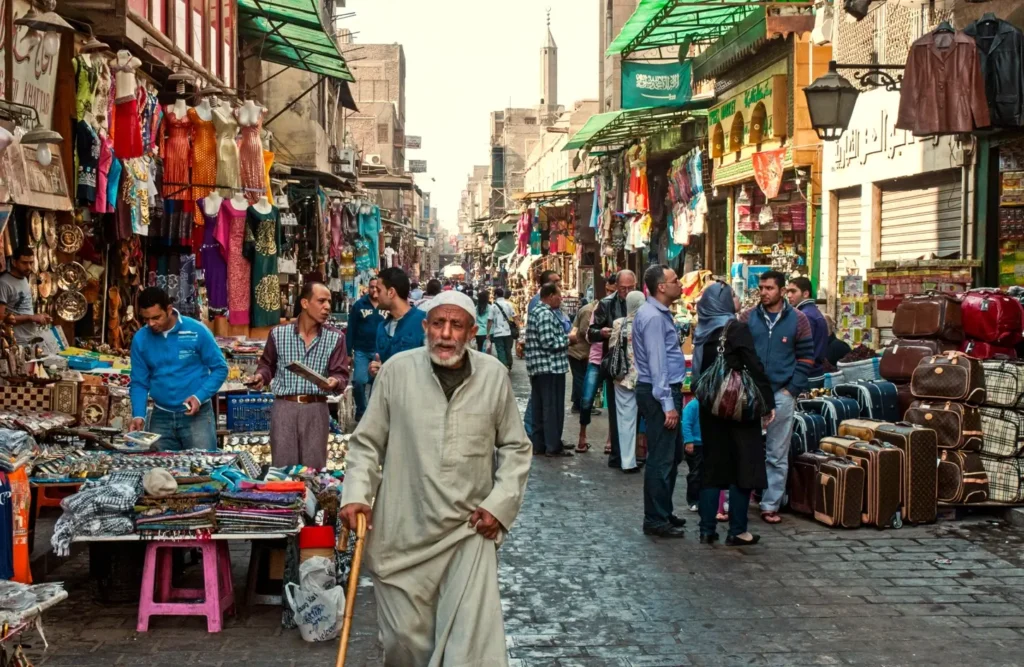
Papyrus, cartouche jewellery, spices, perfume oils, scarves and gold are the usual purchases. Wikivoyage notes that Khan el-Khalili in Cairo sells almost any kind of souvenir, from scarves and water pipes to gold and silver. Wikipedia adds that some craft workshops still operate in the courtyards and upper floors of the bazaar, and that its first Khan was built between 1382 and 1389.
Spices are a simple buy. Wikivoyage says dried herbs and spices are generally of higher quality than in Western supermarkets, at prices often a fifth to a quarter as high. Perfume oils need one check: Wikivoyage advises asking the seller to prove that no alcohol has been mixed in.
A cartouche is a metal plate shaped like an elongated oval, engraved with your name in hieroglyphs (Wikivoyage). Ask someone who reads hieroglyphs to check the spelling before you pay.
Related tripsEgypt tour packages63 private trips from 2 to 15 days.How do you tell real papyrus from a fake?
Hold the sheet up to a light. The Brooklyn Museum explains that papyrus is made from strips of the stem pith, soaked and laid in a first layer, with a second layer placed across it at a right angle, then pressed. That two-layer structure shows as a grid in transmitted light, with dark fibre lines crossing in both directions.
Fakes are common. Wikivoyage says most papyrus you will see is made of a different reed, and that you should assume an item is not authentic if you are unsure. Real papyrus is not extinct as a craft: Wikipedia credits a technique developed in 1962 by Hassan Ragab for the Egyptian tourist trade, so genuine sheets are available.
A short checklist:
- Hold the sheet to a light and look for a two-direction grid. Long parallel veins with no crossing layer are a warning sign.
- Ask the seller to show you how a sheet is made.
- If the seller cannot explain it, or the answer changes, buy elsewhere.
How do you buy gold and cartouche jewellery safely?
Gold must be tested and stamped before sale under Egypt’s Assay and Weights Authority, according to Egyptian Streets (4 May 2026). The same report warns that counterfeiters can now copy stamps, so a visual check is not enough. Its advice is to check the karat stamp and hallmark, insist on a detailed invoice, compare the price with the market, and have the piece tested if you are unsure. Egypt accredited its first X-ray gold-testing lab in October 2025.
Al-Ahram reported in January 2022 that a laser stamp would replace the traditional iron stamp from 2023, with a QR code that records details such as weight, producer and karat. Ask the seller to show you that information on the piece or tag.
A price far below the market rate is a warning sign. The source quotes a dealer saying the same.
How do you bargain in Egypt?
Haggling is expected in bazaars and with street vendors. Wikivoyage calls it a part of the game both sides play, and says merchants used to tourists often quote very high first prices. Not every shop haggles, so if prices are marked, ask before you start.
- Look at the same item in two or three shops before you start.
- Decide your top price before you ask, and do not go above it.
- Make your first offer well below your top price, and stay friendly.
- Be ready to walk away. A real offer often follows.
- Agree the price, the currency and what is included before you say yes.
- Ask for a receipt for anything valuable.
Keep an eye on your bag. Wikivoyage describes Khan el-Khalili as infamous for pickpockets.
Which souvenirs are cheaper or better in which city?
Buy by city, not all in one place. Wikivoyage describes the markets differently from one city to the next, and that is the practical way to plan your shopping.
| City | Where | Best for | Watch for |
|---|---|---|---|
| Cairo | Khan el-Khalili and Islamic Cairo | Replica statues, lanterns, cotton goods, gold and silver | High first prices; pickpockets |
| Luxor | An air-conditioned hall and the older market near Luxor Temple | Comparing the same item across many shops | Intense touting in the main souq; imported alabaster |
| Aswan | Sharia as-Souq, from the railway station south | Nubian baskets, talismans and spices | Blatant pickpocketing; other goods cost more than in Cairo |
Wikivoyage calls the Aswan souq the most charming in Egypt and says there is far less pressure to buy than in other cities. It also says Nubian handicrafts are better value in Aswan, while most other goods cost more there than in Cairo because of shipping costs and lower tourist demand. So buy Nubian pieces in Aswan and leave the rest for Cairo or Luxor.
What is wrong with alabaster and other stone goods?
Often, the stone did not come from where you are standing. Wikivoyage’s Luxor page says a large percentage of the alabaster on sale is imported and hardly made on site, and that other stones sold there, such as jade, mostly come from China and India. That is the guide’s claim, stated without a source, so treat it as a reason to ask questions, not as a fact about every shop.
A fair test is simple. Ask where the piece was carved and by whom. If the answer is vague, price it as a factory item and pay accordingly.
Is kohl a safe souvenir?
Not to use on skin, and especially not for children. Wikivoyage says kohl powder is sold cheaply in many stores, in a small packet or a carved wooden container, and that most of it contains lead sulphide. It suggests asking for lead-free kohl. The US Food and Drug Administration says kohl, kajal and surma often contain high lead levels, that lead can make up more than half of the product’s weight, and that children face the greatest risk.
The FDA also says none of these materials is approved for cosmetic use in the United States, and that its Import Alert 130 covers eye cosmetics declaring kohl, kajal or surma on the label. If you want the carved container as a keepsake, buy it empty or as decoration and keep it away from children. Check your own country’s import rules for cosmetics before you pack it.
What about cotton, lanterns and other crafts?
Egyptian cotton is a real category. Wikipedia describes it as Gossypium barbadense grown in Egypt, sometimes called long-staple or extra-long staple. Wikivoyage says better-quality cotton goods are sold at the chains Mobaco Cottons and Concrete, which have many branches, and that cotton items are also sold in Khan el-Khalili. A chain gives you a fixed price to compare against the bazaar quote.
Lanterns (fanus) are stamped metal with coloured glass, built to hold a small candle. Inlaid backgammon boards, alabaster bowls, brass rings and spices are the other common finds. Wikivoyage notes that real craftsmen in fine gold and silver are hard to identify, so a bazaar goldsmith is a gamble unless you can test the piece.
How do you read prices if you cannot read Arabic numerals?
Learn the Eastern Arabic numerals. Wikivoyage says prices are often raised for foreigners and recommends knowing the numerals so you can read price tags yourself. It also warns that older guides may quote Egyptian pound prices that are out of date after the 2024 devaluation, so never use a printed figure as your starting point.
For Luxor, Wikivoyage gives a bargaining example: if you are asked for six times what you would pay, make a low offer and move up slowly to your limit. It adds that opening prices can be ten or even a hundred times a reasonable one. Treat that as the guide’s experience, not a rule, and set your own maximum before you start.
Are old objects from the 1800s allowed to leave?
Not if they are more than 100 years old, unless officially authorised. Wikivoyage says 19th century and later antiques, such as 1880s dishes or pistols, are on sale, and that real antiquities cannot legally be traded. The Government of Canada rule quoted above covers any item older than 100 years. An 1880s dish is older than that, so ask for documents and check with the Ministry of Tourism and Antiquities before you buy it. A 1930s typewriter is a different case, but the age should be on the invoice.
What should you skip?
- Anything sold as a genuine antiquity, with or without a certificate.
- Kohl for use on skin.
- Papyrus you cannot hold to a light in the shop.
- Gold from a seller who will not give a detailed invoice.
- Large alabaster pieces if you only want a keepsake: they are heavy, and the origin is often unclear.
How does souvenir shopping fit a trip?
Keep one afternoon for it, not a whole day. A short, planned visit to Khan el-Khalili in Cairo with a price ceiling in mind works better than wandering for hours, and you can leave Aswan for Nubian crafts only. Wikivoyage also warns about a common line in Luxor, “the temple is closed”, and advises checking opening times yourself, since the main temples rarely close and the Valley of the Kings ticket office posts which tombs are open each day.
Can you take antiquities out of Egypt?
No. Exporting an antiquity is illegal. The Government of Canada’s Egypt advice, checked on 28 October 2026, says it is prohibited to export any antiquity or any item older than 100 years unless officially authorised. Do not buy anything that a seller calls a real antiquity, whatever the story or the certificate. Do not pick up stones, pottery or sand at a site.
Replicas are a different matter. A new copy is neither an antiquity nor older than 100 years, so it is not what that rule covers. The Ministry of Tourism and Antiquities runs a replica factory, and its news pages say the replicas are made in Egypt, carry a Supreme Council of Antiquities stamp and have a barcode for identification. The factory employs more than 150 Egyptian artists and skilled workers. Egypt Independent reported in March 2021 that these replicas would go to hotels and tourist bazaars.
Buy from a shop that says plainly that the piece is a replica, and keep the invoice. If you are unsure whether an object is old, ask the Ministry of Tourism and Antiquities before you buy, not at the airport. This is a plain summary of the rule, not legal advice, so check the current rules before you travel.
Who is souvenir shopping in Egypt for, and who should skip the bazaars?
It suits travellers who enjoy talking and comparing, and who treat the first price as a start. It is not ideal if haggling wears you out or you want fixed prices everywhere. In that case, shop in a place with marked prices and buy fewer, simpler items.
A day with a guide through Cairo is a calm way to see the markets; see our day tours or plan my trip.