
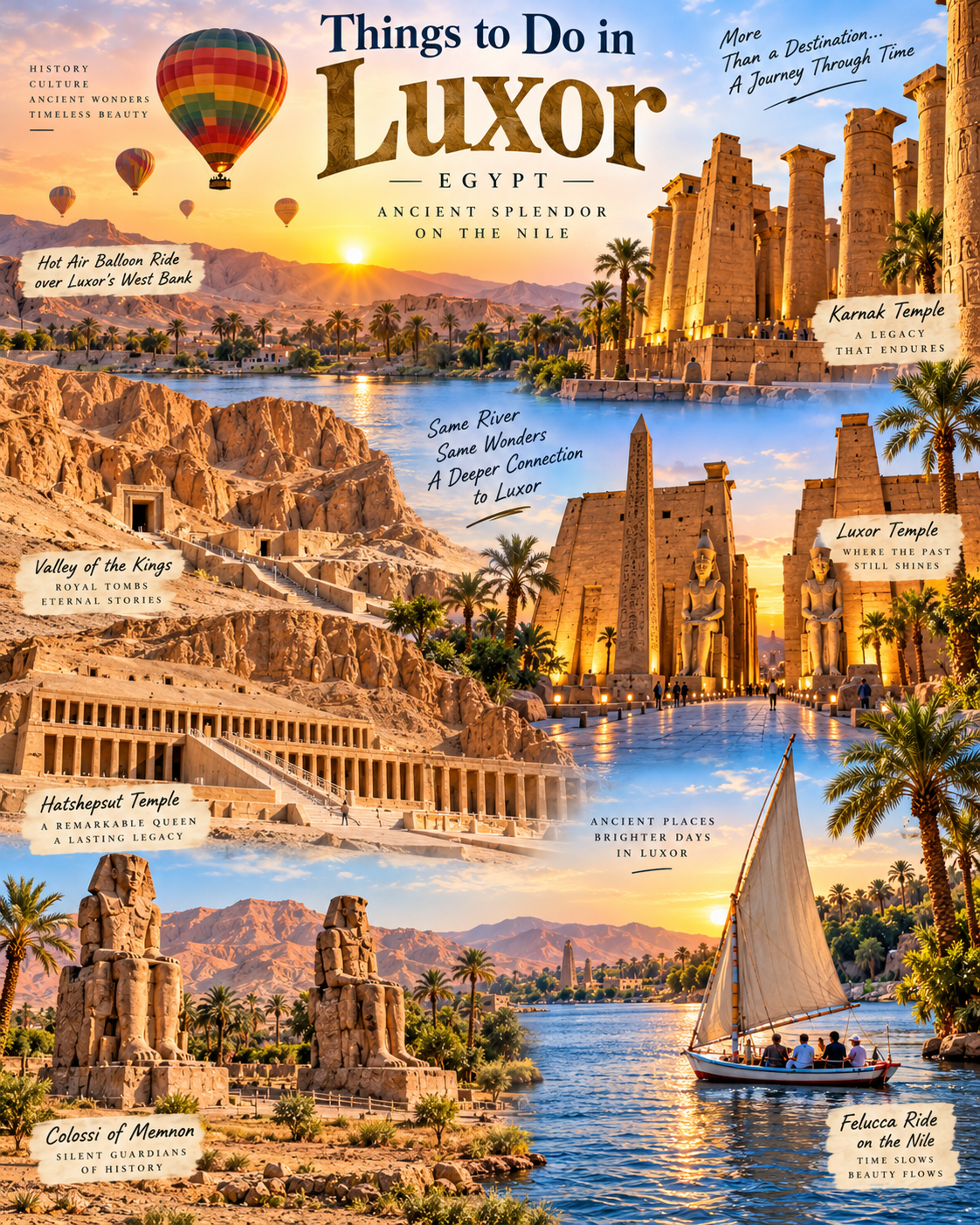

Luxor is one of the most extraordinary destinations in Egypt and one of the best places in the world for travelers interested in ancient history.
Located along the Nile in Upper Egypt, modern Luxor stands on the site of ancient Thebes, one of the most important cities of ancient Egypt. The city contains spectacular temples, royal tombs, colorful wall paintings, enormous statues, archaeological sites, museums, traditional markets, Nile scenery, and unforgettable experiences such as hot air balloon rides.
Luxor is divided by the Nile into two main sightseeing areas. The East Bank contains famous attractions such as Karnak Temple and Luxor Temple, while the West Bank is home to the Valley of the Kings, Valley of the Queens, Temple of Hatshepsut, Medinet Habu, and many other ancient sites.
Because so many important monuments are concentrated around the city, Luxor is often described as an open-air museum.
At Egypt Best Excursions, we created this detailed guide to the best things to do in Luxor to help you plan your visit and decide which attractions deserve a place on your itinerary.
Whether you are spending one day in Luxor, staying for several nights, or visiting as part of a longer Egypt and Nile cruise itinerary, these are some of the experiences you should not miss.
1. Explore Karnak Temple
Karnak Temple is one of the most impressive archaeological sites in Luxor and one of the most important places to visit during your trip.
Rather than being a single temple, Karnak is an enormous religious complex that developed over many centuries.
Different rulers added pylons, courtyards, temples, statues, obelisks, chapels, columns, and other structures, creating a site that demonstrates the enormous power and importance of ancient Thebes.
One of the most famous areas is the Great Hypostyle Hall.
Walking between its enormous columns is one of the most memorable experiences in Luxor.
The columns are covered with carvings and hieroglyphs, while sections still preserve traces of ancient color.
Visitors should also look for the towering obelisks, sacred lake, statues, and smaller temples throughout the complex.
Karnak is much larger than many first-time visitors expect, so avoid planning to walk through it too quickly.
Give yourself enough time to explore the site and observe smaller details instead of concentrating only on the most famous monuments.
Read our detailed guide to Karnak Temple .
You can also explore our Luxor Day Tours if you prefer an organized sightseeing experience.
2. Visit Luxor Temple
Luxor Temple is another essential archaeological attraction on the East Bank.
While Karnak impresses visitors with its enormous scale, Luxor Temple offers a different atmosphere.
The temple stands close to the modern city and creates an extraordinary contrast between ancient Egyptian architecture and everyday contemporary Luxor.
Visitors enter through a monumental entrance associated with Ramesses II. Large statues, columns, courtyards, hieroglyphs, and ancient architectural details can be found throughout the complex.
Luxor Temple is particularly beautiful later in the day.
Visiting around sunset allows you to see the sandstone structures in warm light before the temple becomes illuminated at night.
The lighting creates dramatic shadows around the columns and statues and makes an evening visit completely different from daytime sightseeing.
Karnak and Luxor Temple can easily be visited on the same day because both are located on the East Bank.
Learn more in our complete guide to Luxor Temple .
You can also consider our Karnak and Luxor Temple Tour .
3. Walk Along the Avenue of Sphinxes
One of the most interesting ways to understand the relationship between Luxor Temple and Karnak is through the Avenue of Sphinxes.
This ancient ceremonial route connects the two major temple complexes.
Rows of statues line the route, helping visitors imagine the processions that once moved through ancient Thebes during important religious festivals.
Walking along part of the avenue provides a different experience from exploring an individual temple.
Instead, you begin to understand how the ancient city functioned as a larger religious landscape.
The avenue is also excellent for photography, particularly when the light becomes softer in the late afternoon.
If you have enough time, combine the Avenue of Sphinxes with both Karnak and Luxor Temple for a complete East Bank experience.
4. Discover the Valley of the Kings
The Valley of the Kings is one of the most famous archaeological sites in Egypt and one of the main reasons travelers visit Luxor.
Located on the West Bank, the valley became the burial place of many ancient Egyptian pharaohs.
Instead of building enormous visible pyramids, rulers created tombs cut deep into the surrounding mountains.
Walking into these tombs is an extraordinary experience.
Long corridors lead underground toward burial chambers decorated with hieroglyphs, gods, stars, religious texts, and colorful scenes representing the pharaoh’s journey into the afterlife.
Different tombs offer different experiences.
Some are famous for their size, while others are especially impressive because of their preserved colors and detailed decoration.
Not every tomb is necessarily open at the same time, and access arrangements can change to help protect the ancient paintings.
Because of this, check current entrance arrangements when planning your visit.
Read our complete guide to the Valley of the Kings .
5. Visit the Tomb of Tutankhamun
Tutankhamun is one of the most famous pharaohs in the world, largely because of the remarkable discovery of his tomb in the Valley of the Kings.
The tomb was discovered by Howard Carter in 1922 and became one of the most important archaeological discoveries associated with ancient Egypt.
Compared with several other royal tombs, Tutankhamun’s tomb is relatively small.
However, its historical importance makes it one of the most interesting places in the Valley of the Kings.
The discovery became famous because much of the burial equipment had survived inside the tomb.
Today, visitors interested in Tutankhamun can combine a visit to his tomb with the other royal tombs throughout the valley.
Check current ticket arrangements because some special tombs may require an additional entrance ticket.
6. Explore the Tomb of Ramesses VI
Travelers who love ancient Egyptian art should consider visiting the Tomb of Ramesses VI.
The walls and ceilings contain extraordinary religious scenes and astronomical imagery.
The burial chamber is particularly impressive.
Looking upward reveals elaborate decoration connected with ancient Egyptian beliefs about the night sky, rebirth, and the journey of the sun.
One of the pleasures of visiting the Valley of the Kings is comparing different tombs.
The layouts, colors, decoration, and preservation vary, allowing you to see how royal burial traditions changed over time.
7. Visit the Temple of Hatshepsut
The Mortuary Temple of Hatshepsut at Deir el-Bahari is one of the most recognizable attractions on Luxor’s West Bank.
The temple was constructed for Hatshepsut, one of ancient Egypt’s most famous female rulers.
Its design is dramatically different from many other Egyptian temples.
Large terraces rise toward the cliffs behind the structure, creating an architectural composition that seems to blend directly into the surrounding mountains.
As you approach, the scale of the temple becomes increasingly impressive.
Visitors can climb through different levels and examine columns, statues, sanctuaries, and decorated walls.
Some of the most interesting reliefs are connected to important events from Hatshepsut’s reign.
The desert landscape around the temple also creates excellent photography opportunities.
Because the West Bank can become very hot, visiting earlier in the day is often more comfortable.
Learn more about the Temple of Hatshepsut .
8. See the Colossi of Memnon
The Colossi of Memnon are two enormous seated statues located on Luxor’s West Bank.
They originally stood at the entrance to the mortuary temple of Amenhotep III.
Although much of the ancient temple complex disappeared over time, the colossal statues remain standing.
Their scale becomes much more impressive when seen in person.
Many West Bank tours stop here because the statues are conveniently located along routes leading toward other archaeological attractions.
The visit normally does not require as much time as the Valley of the Kings or Hatshepsut Temple, but the Colossi are an important part of the historical landscape.
9. Explore the Valley of the Queens
The Valley of the Queens is another important ancient burial area on the West Bank.
Members of ancient Egyptian royal families, including queens and royal children, were buried here.
Although the Valley of the Kings receives more international attention, travelers interested in Egyptian art should not automatically overlook the Valley of the Queens.
Several tombs contain beautiful wall paintings and detailed decoration.
The most famous is the Tomb of Queen Nefertari.
Because access to certain tombs and ticket arrangements may vary, check current visitor information when planning your trip.
10. See the Tomb of Queen Nefertari
The Tomb of Queen Nefertari is often considered one of the most beautiful tombs in Egypt.
Nefertari was the famous wife of Ramesses II, and her tomb is celebrated for its remarkable paintings.
Rich colors cover walls and ceilings, while religious scenes depict the queen’s journey through the afterlife.
The artistic quality creates a dramatically different experience from simply viewing enormous temples from outside.
Here, visitors encounter ancient Egyptian art at a much more intimate scale.
Special entrance arrangements may apply, so travelers who consider this tomb a priority should confirm current availability before visiting.
11. Visit Medinet Habu
Medinet Habu is one of Luxor’s most impressive archaeological sites and is sometimes overlooked by travelers trying to see only the most famous attractions.
The complex is best known for the mortuary temple of Ramesses III.
Its walls contain detailed reliefs showing religious ceremonies, royal activities, and military scenes.
Some carvings remain remarkably deep and clear.
Another advantage of Medinet Habu is that it may feel less crowded than some of Luxor’s most famous attractions.
That can make it easier to slow down, look closely at the reliefs, and appreciate the architectural scale.
Photography enthusiasts should allow plenty of time because columns, courtyards, walls, and gateways provide many different compositions.
12. Explore Deir el-Medina
Deir el-Medina provides a fascinating opportunity to learn about people who were not pharaohs.
The ancient settlement housed skilled workers and artisans connected with the creation and decoration of royal tombs.
That makes the site particularly interesting because it reveals another side of life in ancient Egypt.
Instead of focusing exclusively on royal monuments, visitors can learn about the people whose work helped create them.
The site includes remains of houses as well as tombs decorated for members of the community.
The paintings inside some of these tombs can be remarkably colorful.
For travelers with a strong interest in archaeology, Deir el-Medina is one of the most rewarding additions to a West Bank itinerary.
13. Visit the Tombs of the Nobles
The Tombs of the Nobles provide another opportunity to explore beautifully decorated ancient Egyptian tombs.
Instead of belonging primarily to kings, these tombs were created for officials, administrators, priests, and other important individuals.
The decoration can be especially interesting because some scenes show activities connected with everyday life.
Agriculture, food preparation, celebrations, work, and social activities can provide a different perspective on ancient Egyptian civilization.
Travelers who have already visited several royal tombs may particularly enjoy the change in subject matter.
14. Take a Hot Air Balloon Ride Over Luxor
Taking a hot air balloon ride is one of the most unforgettable things to do in Luxor.
Flights commonly take place around sunrise, when the early morning light spreads across fields, villages, desert mountains, temples, and the Nile landscape.
From above, the relationship between Luxor’s agricultural land and dry desert becomes especially clear.
You may see archaeological areas, mountains, villages, and the Nile landscape from a completely different perspective.
The early departure may require waking up well before sunrise, but many travelers consider the experience worth the early start.
Weather conditions are important for balloon operations, so schedules can sometimes change for safety reasons.
If this experience is one of your priorities, see our guide to Hot Air Balloon in Luxor .
15. Visit Luxor Museum
After seeing Luxor’s enormous archaeological sites, visiting Luxor Museum provides an opportunity to examine individual artifacts more closely.
The museum is located on the East Bank near the Nile.
Its collection includes ancient statues and archaeological objects associated with Luxor and the surrounding region.
A museum visit helps connect objects with the temples and tombs you have already explored.
It is also a useful option during the hotter part of the day when you may want a break from outdoor archaeological sites.
Visitors who enjoy museums should consider combining Luxor Museum with a walk along the Corniche and an evening visit to Luxor Temple.
16. Visit the Mummification Museum
Mummification played an essential role in ancient Egyptian religious beliefs about death and the afterlife.
Luxor’s Mummification Museum allows visitors to learn more about the techniques, objects, beliefs, and materials connected with the process.
This can be particularly useful after visiting the Valley of the Kings or other burial sites.
Instead of seeing tombs only as beautiful decorated spaces, you gain more context about the beliefs and practices surrounding ancient Egyptian burial.
The museum does not require an entire day, making it easy to include with other East Bank attractions.
17. Sail on the Nile by Felucca
Luxor is famous for archaeology, but not every moment of your trip needs to be spent inside temples and tombs.
A felucca ride on the Nile provides a peaceful change of pace.
Traditional sailing boats move along the river while you watch Luxor’s riverbanks, palm trees, fields, boats, hotels, and distant mountains.
Late afternoon is especially enjoyable.
As temperatures begin to fall, the sunset creates warm colors across the Nile and surrounding landscape.
A felucca trip can be a romantic experience for couples, but it is equally enjoyable for families, solo travelers, and groups.
It also gives you time to relax after a demanding morning of archaeological sightseeing.
18. Watch the Sunset Over the Nile
Sunset in Luxor deserves to be treated as an activity rather than simply the end of the day.
The Nile, palm trees, West Bank mountains, boats, and changing colors create a beautiful scene.
You can watch sunset from a felucca, riverside restaurant, hotel rooftop, or the Corniche.
If you have spent the entire day walking through archaeological sites, sitting beside the Nile provides a welcome opportunity to slow down.
For photographers, the changing light can create excellent opportunities for landscape and travel photography.
19. Walk Through Luxor Souq
Luxor’s traditional market provides a completely different experience from the ancient monuments.
Shops sell spices, clothing, textiles, jewelry, souvenirs, perfumes, and local products.
Walking through the market gives travelers an opportunity to experience modern everyday life alongside the ancient history for which Luxor is famous.
Bargaining is common in many souvenir shops, so remain friendly and decide how much you are willing to pay before making a purchase.
If you are looking for gifts, you may also find our guide to Egypt Souvenirs helpful.
20. Experience Karnak Temple at Night
Karnak Temple is impressive during the day, but visiting the area after dark can provide another type of experience.
Lighting transforms the huge columns, statues, walls, and courtyards, creating a dramatic atmosphere.
Travelers interested in an evening activity can consider the Karnak Sound and Light Show.
The experience combines the archaeological surroundings with lighting and storytelling.
See our Karnak Sound and Light Show .
21. Explore Luxor by Bicycle
Cycling can be an enjoyable way to see certain parts of Luxor, particularly on the West Bank.
Away from the busiest archaeological attractions, roads can pass through agricultural areas, villages, palm trees, and fields.
This gives travelers a chance to experience the landscape between the monuments instead of moving everywhere by vehicle.
Morning is usually more comfortable because temperatures are lower.
Always consider weather, traffic, road conditions, and your own cycling experience before choosing this option.
22. Experience Local Life on the West Bank
The West Bank contains some of Egypt’s most important archaeological sites, but it is also home to modern communities, farmland, restaurants, guesthouses, and small businesses.
Spending some time outside the major attractions gives you a different perspective on Luxor.
Fields create a vivid green contrast with the surrounding desert mountains.
Donkeys, motorcycles, local boats, farmers, and village streets show the daily rhythm of Upper Egyptian life.
Stop at a local restaurant or cafe instead of immediately returning to your hotel after sightseeing.
Travel often becomes more memorable when historical attractions are combined with ordinary everyday experiences.
23. Take a Nile Cruise From Luxor
Luxor is one of the main starting or ending points for Nile cruise itineraries through Upper Egypt.
A cruise allows travelers to combine archaeological sightseeing with the experience of traveling along the Nile.
Instead of taking a road directly from one destination to another, you can watch agricultural land, villages, palm trees, desert landscapes, boats, and riverside communities pass slowly beside you.
Many itineraries connect Luxor with Aswan while visiting important temples along the route.
This can be an excellent extension to a Luxor stay because it provides a more complete Upper Egypt experience.
Browse our Egypt Nile River Cruises .
Travelers looking for a more luxurious experience can also explore our Luxury Nile Cruises .
For a more traditional sailing experience, see our Dahabiya Nile Cruises .
24. Visit Luxor From Hurghada
Travelers staying on Egypt’s Red Sea coast often want to experience ancient Egypt without completely changing their beach vacation.
Luxor can be combined with a stay in Hurghada through an excursion to the Nile Valley.
A Luxor trip allows Red Sea visitors to experience temples, tombs, and ancient history before returning to the coast.
Because the journey requires significant travel, carefully consider whether a day trip or overnight visit works better for your schedule.
An overnight stay gives you additional time and reduces the pressure to fit many attractions into a single day.
Travelers interested in this option can see our Overnight Luxor Tours From Hurghada .
You can also browse our complete collection of Hurghada Excursions .
25. Spend More Than One Day in Luxor
Luxor contains enough major attractions to justify more than a rushed single-day visit.
A one-day itinerary is possible, but it normally requires choosing between several important sites.
Spending two or three days creates a much better experience.
Day 1: Luxor East Bank
Start with Karnak Temple before visiting Luxor Museum or relaxing during the middle of the day.
Later, explore Luxor Temple around sunset and enjoy the atmosphere after dark.
Day 2: Luxor West Bank
Start early at the Valley of the Kings.
Continue to the Temple of Hatshepsut and Colossi of Memnon.
If you have enough time, add Medinet Habu or another West Bank archaeological site.
Day 3: Deeper Luxor Experience
Begin with a sunrise hot air balloon ride.
Later, visit the Valley of the Queens, Deir el-Medina, Tombs of the Nobles, or additional West Bank attractions.
Finish your stay with a sunset felucca ride on the Nile.
Travelers looking for organized excursions can browse our Luxor Day Tours .
East Bank vs West Bank in Luxor
Understanding the difference between Luxor’s East Bank and West Bank makes planning your itinerary much easier.
Luxor East Bank
The East Bank contains much of modern Luxor as well as some of its most famous ancient monuments.
Major attractions include Karnak Temple, Luxor Temple, the Avenue of Sphinxes, Luxor Museum, and the Mummification Museum.
Hotels, restaurants, shops, the Corniche, and many transportation services are also located here.
Luxor West Bank
The West Bank contains the famous Theban necropolis and numerous royal and funerary sites.
Important attractions include the Valley of the Kings, Valley of the Queens, Hatshepsut Temple, Medinet Habu, Deir el-Medina, Tombs of the Nobles, and the Colossi of Memnon.
Travelers with at least two days should normally dedicate substantial time to both sides of the Nile.
How Many Days Do You Need in Luxor?
Two days is a good minimum for travelers who want to see the major Luxor attractions without rushing excessively.
One day can cover highlights from both banks, but the itinerary will be intensive.
Three days provides a better balance.
You can spend one day exploring the East Bank, another day visiting major West Bank attractions, and the third day discovering smaller archaeological sites or enjoying a hot air balloon and Nile experience.
Travelers who are deeply interested in Egyptology could easily spend even longer.
Luxor contains numerous temples and tombs beyond the most famous locations, so additional days allow you to explore at a much more relaxed pace.
Best Time to Visit Luxor
Weather is an important consideration when planning a Luxor vacation.
Many of the major attractions are outdoor archaeological sites with limited shade.
During hotter periods, temperatures can make long sightseeing days more demanding.
Starting early in the morning is one of the best strategies.
You can explore outdoor archaeological sites while temperatures are more comfortable and use the middle of the day for lunch, museums, or rest.
Late afternoon is another excellent period for outdoor sightseeing, especially around Luxor Temple and the Nile.
For a wider seasonal guide, read our article about the Best Time to Visit Egypt .
What Should You Wear in Luxor?
Comfortable lightweight clothing is important for sightseeing in Luxor.
Many archaeological visits require walking across uneven ground, climbing steps, or moving through warm tomb corridors.
Comfortable walking shoes are therefore essential.
A hat, sunglasses, and appropriate sun protection are useful when visiting outdoor sites.
Visitors should also remember that Egypt is generally conservative.
Respectful clothing is recommended, particularly when visiting areas outside major tourist sites or entering religious buildings.
For more cultural information, read our guide to Egypt Customs and Traditions .
Getting Around Luxor
Luxor is smaller and easier to understand than Cairo, but its attractions are divided between the two sides of the Nile.
The East Bank contains the modern city center and major temples, while the West Bank archaeological attractions are spread across a wider area.
Transportation options can include taxis, private vehicles, organized tours, local boats, ferries, and traditional horse-drawn carriages in certain areas.
For a West Bank sightseeing day involving several archaeological sites, arranged transportation can save considerable time.
Crossing the Nile by boat can also be part of the Luxor experience rather than simply transportation.
Things to Do in Luxor at Night
After sunset, temperatures often become more comfortable and Luxor develops a more relaxed atmosphere.
One of the best evening activities is visiting Luxor Temple when the monuments are illuminated.
You can also walk along the Nile Corniche, eat at a restaurant overlooking the river, explore the local market, or relax at your hotel.
Another option is attending the Karnak Sound and Light Show .
If you have spent the morning waking up early for temples and tombs, keep your evening relatively relaxed.
Luxor is best enjoyed when sightseeing is balanced with time beside the Nile.
Things to Do in Luxor for Couples
Although Luxor is primarily famous for ancient history, couples can easily include romantic experiences in their itinerary.
Take an early morning hot air balloon ride and watch the sunrise over the West Bank.
Later, enjoy a sunset felucca ride on the Nile.
You can also choose a rooftop restaurant overlooking Luxor Temple or the river.
Staying at a quieter West Bank hotel or guesthouse may provide a more relaxed atmosphere than remaining entirely in the busy city center.
Couples planning a larger Egyptian vacation can also explore our Egypt Honeymoon Packages .
Things to Do in Luxor With Kids
Luxor can be a fascinating destination for children when the itinerary is planned carefully.
Enormous statues, colorful tombs, temples, boats, and hot air balloons can make ancient history feel much more real than simply reading about it.
However, visiting several temples and tombs consecutively can become tiring for younger travelers.
Mix archaeological sightseeing with lighter experiences such as a Nile boat ride, swimming at the hotel, exploring the market, or enjoying local food.
Start sightseeing early during warm weather and schedule regular breaks.
Families planning a wider trip can also read Egypt With Kids .
Can You Visit Luxor From Cairo?
Yes. Luxor can be combined with Cairo as part of a longer Egyptian vacation.
However, the two cities are far enough apart that Luxor should normally be treated as a separate destination rather than an ordinary road day trip.
Travelers may use domestic flights, trains, or a multi-day itinerary to connect the destinations.
Many Egypt travel packages combine Cairo with Luxor, Aswan, and a Nile cruise.
If you are planning a larger journey, explore our Egypt Vacation Packages .
Can You Visit Luxor From Hurghada?
Yes. Luxor is one of the most popular historical excursions for travelers staying in Hurghada.
The journey allows visitors to combine a Red Sea vacation with some of Egypt’s most important ancient attractions.
Because there is considerable travel involved, some travelers choose an overnight itinerary rather than trying to fit everything into one very long day.
See our Overnight Luxor Tours From Hurghada .
Can You Visit Luxor From Safaga?
Luxor can also be visited from Safaga on Egypt’s Red Sea coast.
This can be particularly useful for travelers staying in the area or arriving as part of a cruise itinerary.
The excursion normally focuses on the most important archaeological attractions depending on the available time.
Travelers can explore our Day Tour From Safaga to Luxor .
Frequently Asked Questions About Things to Do in Luxor
What are the best things to do in Luxor?
The most popular attractions include Karnak Temple, Luxor Temple, the Valley of the Kings, Temple of Hatshepsut, Valley of the Queens, Colossi of Memnon, Medinet Habu, and Luxor Museum.
A hot air balloon ride and Nile felucca trip are also among the best Luxor experiences.
How many days should I spend in Luxor?
Two days is a good minimum for most first-time visitors.
Three days provides a more comfortable itinerary and allows you to visit additional archaeological sites without rushing.
Is one day enough for Luxor?
One day is enough to see several major attractions, but you will have to prioritize carefully.
Staying for at least two nights creates a much more relaxed experience.
Which is better, the East Bank or West Bank of Luxor?
Both are important and provide different experiences.
The East Bank contains Karnak and Luxor Temple, while the West Bank contains the Valley of the Kings, Hatshepsut Temple, Valley of the Queens, and many other burial and funerary sites.
First-time visitors should try to explore both.
Is Karnak Temple worth visiting?
Yes. Karnak is one of Luxor’s most important archaeological attractions and one of the most impressive temple complexes in Egypt.
Its enormous columns, pylons, statues, obelisks, sacred lake, and smaller temples make it an essential part of a Luxor itinerary.
Is the Valley of the Kings worth visiting?
Yes. The Valley of the Kings gives visitors the opportunity to enter ancient royal tombs and see detailed wall paintings, hieroglyphs, and funerary scenes.
It is one of the most important archaeological attractions in Egypt.
Is a hot air balloon ride in Luxor worth it?
For many travelers, a sunrise hot air balloon ride becomes one of the highlights of their Egypt vacation.
The experience provides aerial views of the West Bank landscape, desert, fields, villages, and archaeological areas.
What is the best thing to do in Luxor at night?
Luxor Temple is particularly beautiful after sunset when the ancient structures are illuminated.
Other options include walking beside the Nile, visiting the local market, having dinner overlooking the river, or attending the Karnak Sound and Light Show.
Can I take a Nile cruise from Luxor?
Yes. Luxor is one of the major points used by Nile cruise itineraries through Upper Egypt.
Many cruises connect Luxor and Aswan while visiting important temples along the Nile.
What should I not miss in Luxor?
First-time visitors should try not to miss Karnak Temple, Luxor Temple, Valley of the Kings, Hatshepsut Temple, and at least one Nile experience.
If you have additional time, add Medinet Habu, Valley of the Queens, Deir el-Medina, Luxor Museum, and a hot air balloon ride.
Final Thoughts: Is Luxor Worth Visiting?
Luxor is much more than another stop on an Egypt itinerary.
For travelers interested in ancient history, it can easily become one of the highlights of the entire country.
Few destinations allow you to experience so many extraordinary archaeological sites within one relatively concentrated region.
You can begin your morning floating above the West Bank in a hot air balloon, spend the next few hours walking through the tombs of ancient pharaohs, visit the Temple of Hatshepsut, and finish your afternoon sailing quietly along the Nile.
The next day can be completely different.
Walk between the enormous columns of Karnak, explore Luxor Museum, visit the ancient Avenue of Sphinxes, and watch Luxor Temple become illuminated after sunset.
Stay longer and you can begin exploring archaeological sites that many short-term visitors never see.
Medinet Habu, Valley of the Queens, Deir el-Medina, and Tombs of the Nobles provide a deeper understanding of ancient Thebes and the people who lived there.
Luxor also offers more than archaeology.
The Nile, green farmland, desert mountains, traditional markets, local villages, restaurants, boats, and everyday Upper Egyptian life create a destination that remains interesting even when you are not standing inside a temple.
Instead of trying to see everything in a few rushed hours, give Luxor at least two or three days whenever your itinerary allows.
That additional time gives you the opportunity to enjoy the monuments, rather than simply moving quickly between them.
If you are ready to begin planning your trip, explore our complete Luxor Day Tours with Egypt Best Excursions.
You can also combine Luxor with Cairo, Aswan, the Nile, and the Red Sea by exploring our Egypt Vacation Packages .
Whether you come for the Valley of the Kings, Karnak Temple, a sunrise hot air balloon ride, or a journey along the Nile, Luxor offers experiences that make the ancient history of Egypt feel remarkably close.
0 Comment