
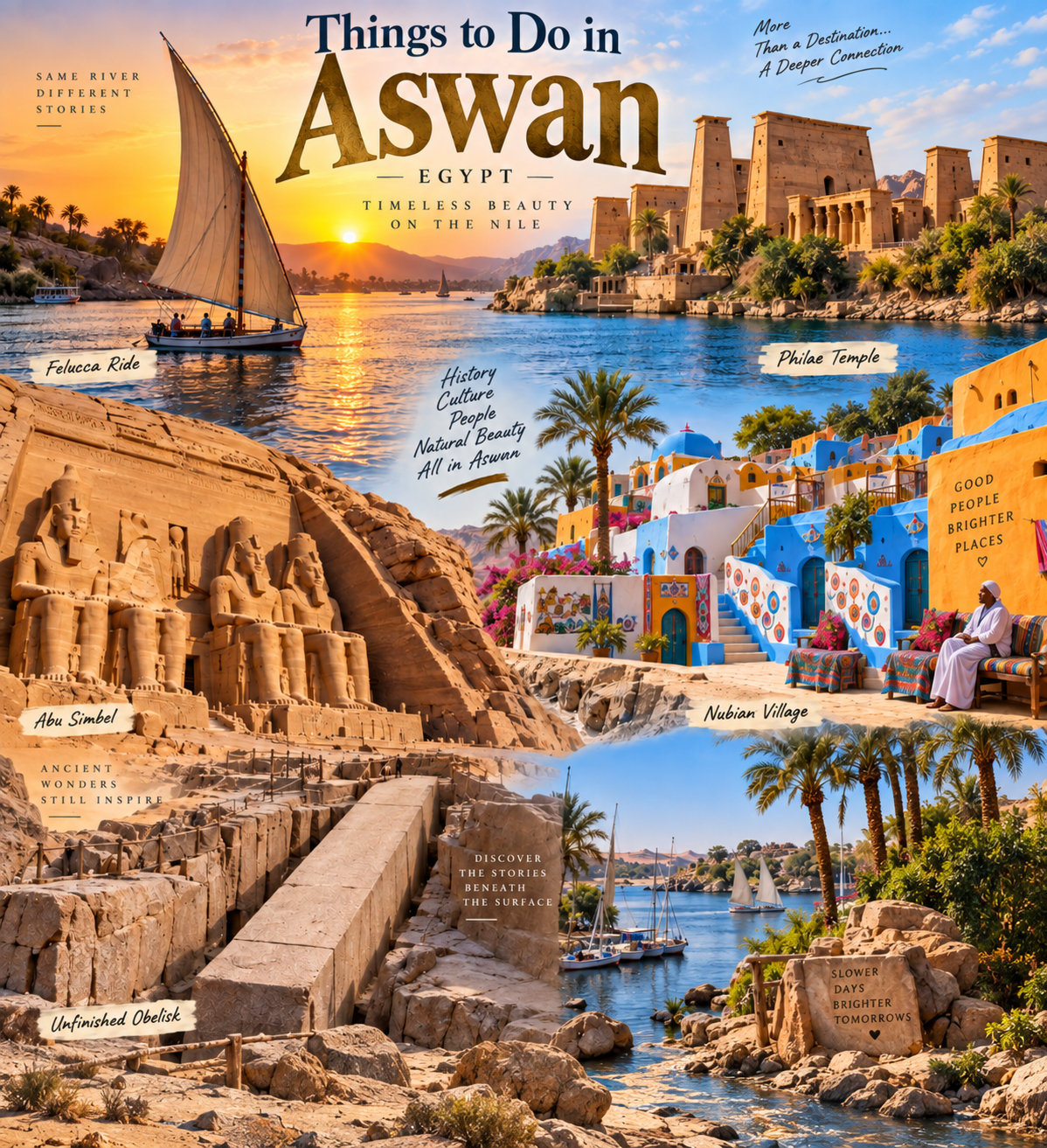

Aswan is one of the most beautiful and relaxing destinations in Egypt. Located along the Nile in southern Egypt, the city combines ancient temples, Nubian culture, colorful villages, desert landscapes, peaceful islands, traditional sailing boats, and some of the most spectacular river scenery in the country.
While Cairo is known for its energy and Luxor for its enormous concentration of ancient monuments, Aswan offers a slower and more peaceful travel experience.
Here, you can sail between islands on a traditional felucca, visit the magnificent Temple of Philae, explore colorful Nubian villages, learn about the construction of ancient obelisks, watch the sunset over the Nile, and take an unforgettable excursion to Abu Simbel.
Aswan was also an important location throughout ancient Egyptian history. Its position close to Egypt’s southern frontier made it an important center for trade, military activity, stone quarrying, and communication with Nubia.
Today, the city remains one of the best places in Egypt to experience both ancient history and living Nubian culture.
At Egypt Best Excursions, we created this guide to the best things to do in Aswan to help you plan your trip and decide which attractions and experiences deserve a place on your itinerary.
Whether you are spending one day in Aswan, staying for several nights, or visiting as part of a Nile cruise between Luxor and Aswan, these are some of the experiences you should not miss.
1. Visit the Temple of Philae
The Temple of Philae is one of the most beautiful attractions in Aswan and one of the essential places to visit during your stay.
The temple complex is closely associated with the goddess Isis and contains impressive pylons, courtyards, columns, sanctuaries, carvings, and hieroglyphs.
One of the things that makes Philae particularly special is its island setting.
Visitors reach the temple by boat, which means the journey itself becomes part of the experience.
As your boat approaches the island, the sandstone temple gradually appears above the Nile, creating one of the most memorable views in Aswan.
The temples now stand on Agilkia Island. They were relocated from their original location as part of the international effort to protect Nubian monuments threatened by changes to the Nile following dam construction.
When exploring the site, take time to examine the large entrance pylons, Temple of Isis, courtyards, columns, reliefs, and the elegant Kiosk of Trajan.
The combination of ancient architecture, water, rocks, and surrounding landscape gives Philae a very different atmosphere from many temples in Luxor.
Read our complete guide to the Temple of Philae .
Travelers who prefer organized sightseeing can also explore our Aswan Day Tours .
2. Take a Day Trip to Abu Simbel
Abu Simbel is one of the most spectacular archaeological attractions in Egypt and one of the most popular excursions from Aswan.
The site is famous for the enormous rock-cut temples created during the reign of Ramesses II.
The Great Temple immediately impresses visitors with four colossal seated figures of the king carved into the facade.
Walking toward these statues is one of the most memorable experiences in southern Egypt.
Inside, visitors can explore halls decorated with reliefs and scenes connected with Ramesses II and ancient Egyptian religion.
Beside the Great Temple is the smaller temple associated with Queen Nefertari and the goddess Hathor.
Abu Simbel is also famous for one of the greatest heritage conservation projects of the twentieth century.
The temples were carefully moved to higher ground to protect them from the rising waters created by the Aswan High Dam project.
Abu Simbel is located far south of Aswan, so visiting requires a significant journey.
Many travelers leave very early in the morning and return later the same day.
If Abu Simbel is one of the main reasons you are visiting southern Egypt, consider giving yourself enough time in Aswan so the excursion does not make the rest of your itinerary too rushed.
You can explore our Private Day Tour to Abu Simbel From Aswan .
3. Sail the Nile on a Traditional Felucca
Taking a felucca ride is one of the best things to do in Aswan.
Feluccas are traditional sailing boats that have traveled along the Nile for generations.
Aswan is particularly well suited to this experience because the Nile here flows between islands, granite rocks, green riverbanks, desert hills, and Nubian communities.
Once the sail catches the wind, the atmosphere becomes remarkably peaceful.
Instead of traffic and busy streets, you hear the movement of the water and the sound of the sail.
Depending on your route, you may pass Elephantine Island, the Botanical Garden, Nubian villages, rocky islands, and traditional boats.
Late afternoon is one of the best times to sail.
As the temperature becomes more comfortable, the light begins changing across the Nile and surrounding desert.
A felucca trip works well for couples, families, groups, and solo travelers.
See our Aswan Felucca Tours if you would like to include the experience in your itinerary.
4. Explore a Nubian Village
One of the experiences that makes Aswan different from many other Egyptian destinations is the opportunity to discover Nubian culture.
Nubian communities have their own rich traditions, language, music, food, crafts, architecture, and cultural identity.
The village of Gharb Soheil is one of the best-known places for visitors interested in experiencing Nubian culture.
Colorful houses decorated with geometric patterns immediately distinguish the village from many other Egyptian communities.
Walking through the village, visitors can browse handicrafts, traditional clothing, jewelry, spices, and other locally produced items.
You may also have the opportunity to drink hibiscus tea, try Nubian food, listen to traditional music, or learn about local customs.
When visiting communities, remember that Nubian culture is living culture, not simply a tourist attraction.
Treat residents, homes, and local customs respectfully and always ask before taking close photographs of people.
5. Enjoy a Traditional Nubian Meal
Food is one of the best ways to experience local culture, and Aswan provides an opportunity to try Nubian dishes as well as more familiar Egyptian food.
A traditional meal can include locally prepared vegetables, rice, bread, meat, chicken, stews, herbs, and regional specialties.
The atmosphere can be just as memorable as the meal itself.
Instead of eating only inside international hotels, consider having at least one meal in a Nubian home or locally operated restaurant.
You may also be offered karkade, the famous hibiscus drink that is closely associated with southern Egypt and Nubia.
Travelers who want a more personal cultural experience can consider our Dinner With a Nubian Family .
If you are interested in Egyptian cuisine more generally, read our guide to Traditional Egyptian Food .
6. Visit the Nubian Museum
Travelers who want to understand Aswan properly should make time for the Nubian Museum.
The museum is dedicated to the history and culture of Nubia and helps visitors understand the region beyond its temples.
Its collections explore Nubian civilization across different historical periods and include archaeological artifacts, traditional objects, photographs, cultural displays, and information about communities affected by major changes along the Nile.
The museum is particularly useful before or after visiting a Nubian village.
Seeing cultural objects and historical information in the museum gives more context to the traditions, architecture, crafts, and customs you encounter elsewhere in Aswan.
It can also be a good attraction during the hotter part of the day because much of the visit takes place indoors.
7. See the Unfinished Obelisk
The Unfinished Obelisk offers one of the most interesting opportunities in Egypt to understand how ancient Egyptians worked with stone.
The enormous obelisk remains connected to the granite bedrock in an ancient quarry.
It was never completed after problems developed during the quarrying process.
Rather than viewing a finished monument standing in front of a temple, here you can see part of the construction process itself.
The site helps visitors understand how ancient workers shaped enormous pieces of granite before transporting them to temples elsewhere in Egypt.
The scale becomes particularly impressive when you walk beside the unfinished monument.
Combine this attraction with other Aswan highlights through our Private Aswan City Tour .
8. Visit the Aswan High Dam
The Aswan High Dam represents a very different period of Egyptian history.
Built across the Nile south of Aswan, the dam had major effects on electricity generation, agriculture, water management, the surrounding landscape, and communities in the region.
Its construction also led to the creation of Lake Nasser.
The rising water threatened numerous ancient monuments, leading to major international campaigns to document, move, and protect important archaeological sites.
Philae and Abu Simbel are among the most famous monuments relocated during these efforts.
A stop at the High Dam can help travelers understand the relationship between modern engineering, the Nile, archaeological conservation, and the creation of Lake Nasser.
It is often combined with Philae Temple and the Unfinished Obelisk during a general Aswan sightseeing tour.
9. Explore Elephantine Island
Elephantine Island sits in the Nile opposite modern Aswan and contains a mixture of archaeological remains, Nubian communities, narrow paths, and river views.
The island played an important role throughout different periods of Egyptian history because of its strategic position near Egypt’s southern frontier.
Visitors interested in archaeology can explore remains connected with the ancient settlement and religious structures.
The island is also interesting because people still live there today.
Walking through local streets allows you to experience a quieter environment than the center of Aswan.
The combination of archaeological remains and living communities makes Elephantine Island particularly interesting for travelers who enjoy seeing different layers of history in the same place.
10. Visit the Ancient Nilometer
Water from the Nile determined the rhythm of life in ancient Egypt.
Nilometers were structures used to measure changes in the level of the river.
These measurements were extremely important because the annual Nile flood was closely connected with agriculture and food production.
Visitors to Elephantine Island can explore an ancient Nilometer and learn more about the relationship between the river and Egyptian civilization.
It may not be as visually dramatic as Abu Simbel or Philae Temple, but it provides valuable insight into how important the Nile was to everyday life.
11. Walk Through Aswan Botanical Garden
After several hours exploring archaeological sites, the Aswan Botanical Garden offers a peaceful change of pace.
Located on an island in the Nile, the garden contains a collection of trees, flowers, and plants from different regions.
Reaching the garden by boat adds to the experience.
Once you arrive, walk slowly beneath the trees and enjoy the contrast between green vegetation, blue Nile water, and dry desert hills.
The garden is a good choice for families, couples, photographers, and travelers who want a break from temples and museums.
Consider combining the garden with a longer felucca trip around Aswan’s islands.
12. Visit the Tombs of the Nobles at Qubbet el-Hawa
The hills across the Nile from Aswan contain ancient tombs belonging to officials who played important roles in the region.
These tombs are often known collectively as the Tombs of the Nobles or the tombs at Qubbet el-Hawa.
The site provides another perspective on ancient Egyptian history because the tombs belonged to regional officials rather than famous pharaohs.
Visitors can also enjoy elevated views over the Nile, Aswan, and surrounding landscape.
The climb and outdoor environment can become hot, so visiting earlier in the day is often more comfortable.
For travelers interested in archaeology, the site can be a rewarding addition after seeing Aswan’s more famous attractions.
13. Visit the Monastery of St. Simeon
The Monastery of St. Simeon is another fascinating historical attraction on the western side of the Nile.
The remains of the monastery provide insight into the Christian history of the Aswan region.
Its desert location creates a completely different atmosphere from the riverside temples.
Exploring the ruins allows visitors to see another stage in the long religious and cultural history of southern Egypt.
The monument is particularly interesting for travelers who want to move beyond the most famous pharaonic sites and discover Aswan’s broader history.
14. See the Aga Khan Mausoleum From the Nile
The Aga Khan Mausoleum is one of the most recognizable structures on the western bank of the Nile in Aswan.
Its position above the river makes it visible from several viewpoints and from boats sailing around Aswan.
Even when access to the building itself is restricted, viewing the mausoleum from the Nile forms part of Aswan’s distinctive river landscape.
A felucca ride provides one of the most pleasant ways to see it together with other landmarks along the river.
15. Explore Aswan Souq
Aswan’s traditional market is one of the best places to experience everyday city life after a day of archaeological sightseeing.
Shops and stalls sell spices, herbs, perfumes, textiles, Nubian handicrafts, clothing, jewelry, souvenirs, dates, and food products.
The colors and aromas are part of the experience.
Southern Egypt is particularly associated with spices and hibiscus, making the market a good place to look for products connected with the region.
Walk slowly rather than treating the souq simply as somewhere to buy souvenirs.
Observe the shops, stop for a drink, and experience the atmosphere.
If you are deciding what to bring home, see our guide to Egypt Souvenirs .
16. Watch the Sunset Over the Nile
Sunset is one of the simplest but most memorable experiences in Aswan.
The city is famous for its Nile scenery, where islands, granite rocks, desert hills, palm trees, sailing boats, and villages create beautiful layers across the landscape.
As the sun moves lower, the colors become warmer and reflections spread across the river.
You can watch the sunset from a felucca, riverside restaurant, hotel terrace, boat, or viewpoint overlooking the Nile.
Unlike an archaeological attraction with a fixed schedule, sunset gives you an opportunity to slow down and appreciate the atmosphere of Aswan.
Keep at least one late afternoon free rather than filling every hour with formal sightseeing.
17. Experience Philae Temple at Night
Philae Temple can also be experienced after sunset.
The island setting becomes especially atmospheric when the temple is illuminated against the dark surroundings.
Travelers looking for an evening activity can consider the Philae Sound and Light Show.
The experience uses lighting and storytelling to present aspects of the temple’s history and mythology.
It can be an interesting option for visitors who have already explored Aswan during the daytime and want a cultural evening activity.
See our Philae Temple Sound and Light Show .
18. Visit the Aswan Museum
The Aswan Museum provides another opportunity to learn about the archaeology and history of the region.
Located on Elephantine Island, the museum contains objects associated with excavations and archaeological discoveries from Aswan and the island.
It can be particularly useful for visitors who have already explored Elephantine’s ancient ruins and want additional historical context.
Because the museum is not as internationally famous as Abu Simbel or Philae, it may also appeal to travelers looking for quieter historical attractions.
19. Take a Lake Nasser Cruise
Lake Nasser offers a completely different cruising experience from the traditional Nile route between Luxor and Aswan.
The enormous lake was created by the construction of the Aswan High Dam and extends deep into the Nubian region.
Cruise itineraries may include archaeological monuments located along the lake, desert landscapes, and eventually the extraordinary temples of Abu Simbel.
The scenery feels remote, with large stretches of water surrounded by desert.
For travelers who have already experienced a traditional Nile cruise, Lake Nasser provides another way to explore southern Egypt.
See our Lake Nasser Cruise options.
20. Visit Kalabsha Temple
Kalabsha Temple is another interesting archaeological site in the Aswan region.
Like several monuments in Nubia, the temple was relocated as part of efforts to protect ancient heritage from rising water.
Its setting near Lake Nasser provides a dramatic combination of ancient architecture, blue water, and desert landscape.
Travelers who have additional time in Aswan may find Kalabsha particularly rewarding because it generally receives less attention than Philae and Abu Simbel.
The wider area also includes additional relocated monuments, making it an interesting destination for travelers deeply interested in Nubian archaeology.
21. Take a Day Trip to Kom Ombo
Kom Ombo is located north of Aswan and is often visited as part of a Nile cruise or road excursion.
The Temple of Kom Ombo is especially unusual because of its symmetrical design connected with two sets of deities.
One side is associated with Sobek, the crocodile god, while the other is associated with Haroeris.
The temple’s location beside the Nile also makes it especially attractive during the late afternoon.
Many travelers encounter Kom Ombo while traveling between Aswan and Luxor, but it can also be included in an excursion from Aswan.
Travelers interested in exploring multiple temples can see our Private Day Trip to Kom Ombo and Edfu Temples From Aswan .
22. Continue to Edfu Temple
Travelers interested in ancient Egyptian temples can continue north from Kom Ombo to Edfu.
The Temple of Horus at Edfu is one of Egypt’s most impressive surviving temple complexes.
Its monumental pylons, courtyards, columns, sanctuaries, inscriptions, and reliefs allow visitors to experience the scale and organization of a major ancient temple.
Combining Edfu and Kom Ombo creates a full day of archaeological sightseeing.
It is particularly suitable for travelers who are staying in Aswan without taking a traditional Nile cruise but still want to experience important temples along the route toward Luxor.
23. Go Bird Watching Around Aswan’s Islands
Aswan is not only an archaeological destination.
The Nile islands, riverbanks, vegetation, and quieter channels also create habitats for different bird species.
An early morning boat trip can provide a peaceful way to experience the natural environment before the day’s main sightseeing begins.
The combination of birds, water, granite rocks, palm trees, and traditional boats creates a side of Aswan that many short-term visitors never experience.
Travelers interested in photography may particularly enjoy the early morning light.
24. Spend Time Along Aswan Corniche
Not every experience in Aswan requires an entrance ticket.
Walking along the Nile Corniche is a simple way to observe daily life and enjoy views of the river.
You can watch feluccas and motorboats crossing the Nile, see Elephantine Island, observe local transportation, and stop at cafes or restaurants.
The Corniche can be especially enjoyable in the evening when temperatures become more comfortable.
Rather than returning immediately to your hotel after sightseeing, spend some time walking beside the Nile and enjoying the slower atmosphere that makes Aswan different from Egypt’s larger cities.
25. Use Aswan as the Beginning or End of a Nile Cruise
Aswan is one of the main starting and ending points for Nile cruises through Upper Egypt.
Many itineraries connect Aswan with Luxor while stopping at important temples along the route.
Cruising allows travelers to combine archaeological sightseeing with the experience of traveling slowly along the Nile.
Instead of simply driving from city to city, you watch agricultural land, villages, palm trees, desert landscapes, and river life pass beside you.
Stops commonly allow travelers to experience archaeological sites between Aswan and Luxor.
Browse our complete selection of Egypt Nile River Cruises .
Travelers looking for a premium experience can also explore our Luxury Nile Cruises .
For a more traditional sailing style, see our Dahabiya Nile Cruises .
How Many Days Do You Need in Aswan?
Two or three days is a good amount of time for many first-time visitors to Aswan.
One day can cover several major city attractions, but adding Abu Simbel makes a longer stay much more comfortable.
Day 1: Aswan Highlights
Visit Philae Temple, the Unfinished Obelisk, the High Dam, and the Nubian Museum.
Finish the day with a sunset felucca ride.
Day 2: Abu Simbel
Start early and travel south to the magnificent temples of Abu Simbel.
After returning to Aswan, keep your evening relaxed and consider walking through the souq or having dinner beside the Nile.
Day 3: Nubian Culture and the Nile
Explore Elephantine Island, visit a Nubian village, spend time in the Botanical Garden, or enjoy a longer felucca journey.
You can also use the third day for Kalabsha Temple, Qubbet el-Hawa, or another archaeological site.
For organized sightseeing, browse our Aswan Day Tours .
Best Time to Visit Aswan
Aswan has a hot desert climate, so weather should be an important consideration when planning your sightseeing schedule.
Many visitors prefer the cooler months because a large amount of sightseeing takes place outdoors.
During hotter periods, begin temple and archaeological visits as early as possible.
Use the hotter middle part of the day for museums, lunch, your hotel, or other activities with more shade.
Late afternoon is one of the most enjoyable periods in Aswan, especially for felucca rides, Nubian village visits, and sunset experiences.
For a complete seasonal overview, read our Best Time to Visit Egypt guide.
Getting Around Aswan
Getting around Aswan is part of the travel experience because several important attractions are located on islands or across the Nile.
Visitors use a combination of cars, taxis, motorboats, ferries, and traditional feluccas.
Philae Temple requires a boat journey, while Elephantine Island and the Botanical Garden are also reached across the water.
For attractions outside central Aswan, organized transportation or a private driver can make sightseeing easier.
Abu Simbel requires a much longer journey and should be planned separately from an ordinary Aswan city tour.
Travelers who prefer arranged transportation can consider our Private Aswan City Tour .
What Should You Wear in Aswan?
Lightweight and comfortable clothing is useful for most Aswan sightseeing.
The sun can be strong, particularly around exposed archaeological sites, so a hat, sunglasses, comfortable walking shoes, and appropriate sun protection can be useful.
Egypt is generally culturally conservative, and respectful clothing is recommended when visiting local communities and religious locations.
When visiting Nubian villages, remember that these are living communities rather than theme parks.
Dress respectfully and ask permission before photographing residents closely.
For more cultural information, read our guide to Egypt Customs and Traditions .
Things to Do in Aswan at Night
Aswan is quieter at night than Cairo, but there are still several enjoyable evening activities.
Walk along the Corniche, visit the souq, have dinner overlooking the Nile, or relax at a riverside cafe.
You can also consider the Philae Temple Sound and Light Show .
Another memorable option is spending the evening enjoying Nubian food and hospitality.
Because daytime sightseeing can involve early starts and hot temperatures, a relaxed evening often works better than an overloaded schedule.
Things to Do in Aswan for Couples
Aswan is one of Egypt’s most romantic destinations because of its peaceful Nile scenery.
Take a private felucca ride around sunset, enjoy dinner beside the river, visit Philae Temple together, or explore the Botanical Garden.
A stay overlooking the Nile can also create a relaxing break between busier sightseeing destinations such as Cairo and Luxor.
Couples planning a larger Egyptian vacation can explore our Egypt Honeymoon Packages .
Things to Do in Aswan With Kids
Aswan can work very well for families because its attractions can be mixed with boat rides and outdoor experiences.
Children may enjoy taking boats between the islands, riding a felucca, exploring the Botanical Garden, seeing colorful Nubian villages, and visiting the enormous temples of Abu Simbel.
Avoid scheduling several long archaeological visits without breaks, particularly during hot weather.
Mix historical attractions with river activities, meals, and time to relax.
Families planning a longer vacation should also read Egypt With Kids .
Can You Visit Aswan From Luxor?
Yes. Luxor and Aswan are commonly combined in the same Egypt itinerary.
Travelers can move between the cities by road, train, organized transfers, or Nile cruise.
A Nile cruise provides the most leisurely option because you can visit temples along the route rather than simply traveling directly between the two cities.
Travelers with limited time may also use organized multi-day itineraries.
One available option is our Overnight Tour to Aswan With Abu Simbel From Luxor .
Frequently Asked Questions About Things to Do in Aswan
What are the best things to do in Aswan?
Top attractions and experiences include Philae Temple, Abu Simbel, the Unfinished Obelisk, Nubian Museum, Elephantine Island, Nubian villages, Aswan Botanical Garden, the High Dam, and a traditional felucca ride on the Nile.
How many days should I spend in Aswan?
Two to three days is ideal for many first-time visitors.
If you want to visit Abu Simbel without rushing the rest of Aswan, at least two nights can make the itinerary much more comfortable.
Is Aswan worth visiting?
Yes. Aswan combines ancient Egyptian and Nubian history with some of the most beautiful Nile scenery in Egypt.
It also offers a noticeably calmer atmosphere than Cairo and provides a different experience from Luxor.
Can you visit Abu Simbel from Aswan?
Yes. Abu Simbel is one of the most popular day trips from Aswan.
Many excursions leave very early in the morning because of the distance between Aswan and Abu Simbel.
Is Philae Temple worth visiting?
Yes. Philae is one of Aswan’s essential attractions.
Its island location, boat journey, monumental pylons, carvings, and connection with the goddess Isis make it one of southern Egypt’s most memorable temple complexes.
What is special about Aswan?
Aswan combines ancient monuments, Nubian culture, islands, traditional feluccas, granite landscapes, desert scenery, and the Nile.
Its slower pace also makes it an excellent destination for travelers who want some relaxation between intensive sightseeing days.
Can you take a Nile cruise from Aswan?
Yes. Aswan is one of the principal starting or ending points for Nile cruises between Aswan and Luxor.
Travelers can choose from different cruise styles, including standard cruise ships, luxury cruises, and more traditional sailing experiences.
What can you do in Aswan at night?
Evening activities include walking through the souq, dining beside the Nile, enjoying Nubian food, relaxing along the Corniche, or attending the Philae Temple Sound and Light Show.
Is Aswan better than Luxor?
The two destinations offer different experiences rather than replacing one another.
Luxor has an extraordinary concentration of large temples and royal tombs, while Aswan is known for beautiful Nile scenery, Nubian culture, islands, Philae Temple, and access to Abu Simbel.
A complete Upper Egypt itinerary should ideally include both cities.
What should I not miss in Aswan?
First-time visitors should try not to miss Philae Temple, a felucca ride, Nubian culture, and at least some of the city’s Nile islands.
If your schedule allows, Abu Simbel should also be high on your itinerary.
Final Thoughts: Is Aswan Worth Visiting?
Aswan is one of the places in Egypt where travelers should resist the temptation to rush.
Its appeal is not based only on checking monuments off a sightseeing list.
The experience comes from combining history, culture, landscapes, and time on the Nile.
You can begin your morning traveling by boat toward the ancient Temple of Philae, spend the afternoon learning about Nubian history, and finish the day watching a white-sailed felucca move across the river at sunset.
Another day might begin before sunrise with a journey to the monumental temples of Abu Simbel.
After returning to Aswan, you can explore the souq, drink hibiscus tea, and enjoy dinner beside the Nile.
Stay longer and you can explore Elephantine Island, visit a Nubian village, walk through the Botanical Garden, discover ancient tombs, see the Unfinished Obelisk, or travel onto Lake Nasser.
Aswan also adds an important cultural dimension to an Egyptian vacation.
The city’s strong Nubian identity introduces travelers to traditions, architecture, food, language, music, crafts, and history that make southern Egypt distinctive.
For many visitors, Aswan becomes a welcome contrast to the fast pace of Cairo and the intensive archaeological sightseeing of Luxor.
The Nile feels especially important here.
It surrounds islands, passes between granite rocks, supports green riverbanks, connects local communities, and provides some of the most beautiful scenery anywhere in Egypt.
If you are building a larger Egypt itinerary, combining Cairo, Luxor, and Aswan creates an excellent introduction to the country.
Cairo introduces the pyramids, major museums, and Egypt’s modern capital. Luxor offers spectacular temples and royal tombs, while Aswan provides Nubian culture, tranquil Nile landscapes, Philae, and access to Abu Simbel.
If you are ready to plan your visit, explore our complete selection of Aswan Day Tours with Egypt Best Excursions.
You can also discover more information about the destination in our Aswan City Egypt guide.
Whether you come for Philae Temple, Abu Simbel, Nubian culture, or simply the experience of sailing peacefully along the Nile, Aswan offers a side of Egypt that deserves far more than a rushed overnight stop.
0 Comment